Guyana's oil boom brings rapid growth, labor shortage and Washington's attention
Published in News & Features
BASSETERRE, Saint Kitts and Nevis — Guyana President Mohamed Irfaan Ali sat behind the table inside a community center here, touting what he described as his nation’s success and an “extraordinary phase in our national development.”
Fourteen new hotels are being built and nearing completion, with another six proposed. A national stadium built to international standards is under construction, and plans are under way for what he described as world-class health care and education.
“We have been able so far to complete six new state-of-the art regional hospitals with all the facilities, and we are now completing the first phase of development of a world-class oncology center,” he added. “We are about 55% completed of the new level five, which is the highest level, maternal and children hospital.”
Once known for its high emigration rates, with as many as 90% of its university-educated citizens moving abroad, Guyana is now a country where the world’s leading fossil fuel companies are competing for a piece of its newfound oil wealth.
“The pace of development has brought us to a situation that is quite opposite to when many of you would have migrated out of Guyana,” Ali, 45, said, speaking to a gathering of Guyanese in Saint Kitts as Terrance Drew, the prime minister of Saint Kitts and Nevis, sat to his left. “Now we have a massive shortage of labor force in Guyana, an extraordinary shortage.”
The country’s new problem, moving from the second-poorest country in the hemisphere after Haiti to an oil-producing state with one of the fastest growing economies in the world — it posted an astounding annual GDP growth 43.8% in 2024 — has been less than 10 years in the making.
That transformation has made Guyana not just one of the countries to watch among its Caribbean and South American neighbors, it has also put the former British colony and its president in the spotlight in Washington.
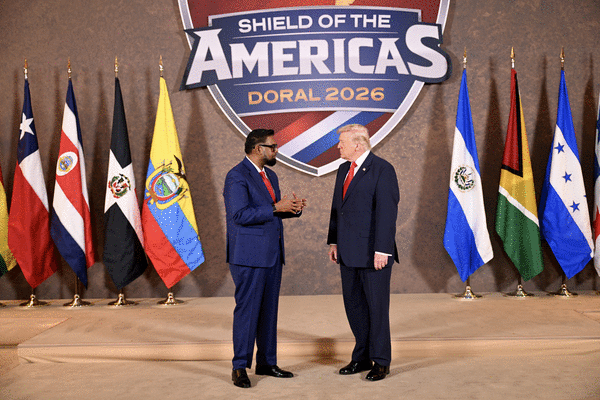
The country is one of just two English-speaking Caribbean nations (the Dominican Republic is also invited) that was invited to participate in Saturday’s Shield of the Americas Summit hosted by President Donald Trump at his golf resort in Doral. The other nation is Trinidad and Tobago.
Both nations are rich in oil, both neighbor Venezuela, both are members of the Caribbean Community bloc — even though Guyana is geographically in South America — and both nations maintain close relations with the United States, which has billed Saturday’s gathering as one of “like-minded allies.”
Yet their leaders have taken different approaches in dealing with Washington. Guyana has leaned toward a strategic alignment, while Trinidad and Tobago, under Prime Minister Kamla Persad-Bissessar, has taken a more outspoken approach in support of Trump that has at times created friction within the region.
Savvy diplomat
Ali “is a very savvy diplomat, and he’s balancing a lot,” Sarah-Ann Lynch, a former U.S. ambassador to Guyana, said. “I think that Washington sees him as a solid bilateral partner, and in this increasingly important region.”
Lynch added Ali is “is also seen as an absolutely pivotal regional player for U.S. interests, especially in energy and security.... I think this is a country to watch, and a president to watch.”
The country, which has had a historical relationship with Cuba, has quietly ended its government-to-government payment structure with the country’s medical brigade under U.S. pressure. And because ethnic Chinese, whose ancestors arrived as indentured servants, account for one of the six people in the country, Ali has also had to balance relations with Beijing.
“They’ve really helped build the social fabric of the country and helped build up the commercial sector,” Lynch said. “So they’re a part of the country. So Guyana will likely continue to have a relationship with China.”
During his visit to Saint Kitts and Nevis for the 50th annual meeting of the Caribbean Community bloc known as CARICOM, Ali declined to address the friction sparked by Persad-Bissessar, who included a defense of Guyana in her opening remarks. She lashed out at the regional bloc, accusing it of not supporting her nation and Guyana against threats from Venezuela.
Instead, he framed this weekend’s invitation in Miami — and a meeting with Secretary of State Marco Rubio while in Saint Kitts — as part of his efforts to strengthen Guyana’s security arrangement with the United States. The U.S. has in recent years come to the country’s defense as it has faced threats from Venezuela over a centuries-old border dispute that was reignited after Guyana discovered oil in 2015.
An Indo-Guyanese who took time during the summit to join fellow Muslims for Taraweeh prayers at the Islamic Center in Basseterre, Ali began his political career in 2006 as a member of Parliament. Today, he fields questions about a backlog of more than 60,000 housing applications and land requests.
“I want you to appreciate one problem,” he said. “Everybody, every single Guyanese across the diaspora, wants a piece of land in Guyana.”
Hesitations in diaspora
Guyana also faces the challenge that for its people living abroad, packing up and returning home isn’t an easy decision.
Despite the country’s oil wealth, data from the Inter-American Development Bank shows that 58% of the 800,000 Guyanese still live in poverty, earning less than $6.85 a day. Another 32% earn under $3.65 a day, placing them in extreme poverty.
“You just can’t pick up and go back like that. You have to have a plan,” said Julian Kendall, 37, who migrated to Saint Kitts 12 years ago from Guyana and lives in Nevis, where he installs kitchens.
Kendall, who worked in the steel industry in Guyana, doesn’t doubt he can make a living back home. But he worries about what kind of work he can find.
“Forty percent of the people are still struggling,” he said.
Ali offered his best pitch, laying out his priorities and where he hopes to take the country after recently winning a second presidential mandate.
The priorities, he said, include food security. He wants to leverage Guyana’s vast farmland and abundant fresh water to build an agricultural ecosystem that could position the country as a major supplier of food across the Caribbean.
That ambition is also tied to Guyana’s broader energy strategy, aimed at ensuring that the region’s fuel needs can increasingly be met from Guyanese production.
Ali also said he and Drew are pursuing a number of development agreements, identifying priorities they will pursue together “in the interest of the development of our countries and the people of our countries.”
One area of partnership will be security. Ali announced the construction of a new internationally accredited police academy in Guyana.
“We have a long history in military training,” he said. “A lot of the military personnel here trained in Guyana, and that training will be expanded.”
Guyana and Saint Kitts and Nevis are discussing cooperation on food security, technology exchanges and workforce training, Ali said.
The Guyana Defense Force is currently working on developing a commercial wing, which Ali said can integrate into expanding the supply chain within CARICOM countries.
One sign of the speed of the country’s development is the transformation of its real estate market, Ali said.
“Almost every piece of land across the coast of Guyana has increased in value by maybe 1,000 percent.”
©2026 Miami Herald. Visit miamiherald.com. Distributed by Tribune Content Agency, LLC.






Comments