Missouri looks to pass anti-trans bathroom bill, following Kansas' sweeping law
Published in News & Features
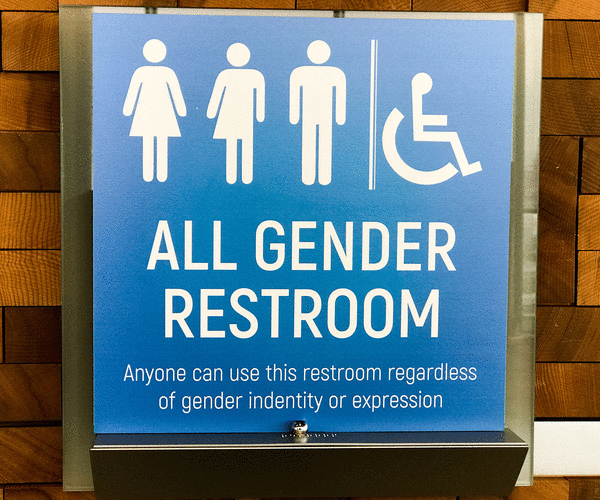
KANSAS CITY, Mo. — Weeks after Kansas lawmakers passed a bill prohibiting transgender individuals from using restrooms and changing rooms consistent with their gender identity, Missouri lawmakers are pursuing their own version of the legislation.
Missouri’s proposed bill, like what passed in Kansas, applies to all public buildings, including schools, colleges and any other state-funded facilities. But unlike Kansas’s bill, it doesn’t include fines and potential jail time for violating the law.
The legislation comes as transgender Kansas Citians are straddling two states that have sought to restrict their rights. The bills in both Kansas and Missouri are part of a wave of legislation regulating the transgender community, stoking fear across the state line.
“The bill establishes a simple standard, which is multi-occupancy facilities must be designated for exclusive use of the male sex only, or the exclusive use of the female sex only,” Rep. Brandon Phelps, a Warrensburg Republican who filed the bill, said at a hearing on Monday.
Phelps said public facilities that don’t comply with the bill would be at risk of losing state funding. He said that the bill wasn’t about excluding anyone, rather that it codified consistent standards for single sex spaces.
Phelps also called it a safety issue, and said predators could abuse “open bathrooms” to victimize women.
“It has nothing to do with transgender issues; this has to do with a grown sexual predator man using open bathrooms as an excuse to track down females,” Phelps said.
But the bill, as written would prohibit transgender individuals from using multi-occupancy bathrooms in public buildings across the state.
The bill received over 600 pages of written testimony in opposition. In person at the hearing, Landon Patterson, a Kansas City-based drag performer and social media influencer, said that if the bill were in place when she was growing up would have prevented her from having a normal experience growing up.
“I transitioned during high school, I used the girls’ restroom, I played on girls’ sports teams, I was fully integrated into my school community, and even voted homecoming queen at Oak Park High School in 2015, ten years ago,” Patterson said. “I want to be very clear, it caused no harm, not to my classmates, not to my school and not to my community.”
Democrats on the House Emerging Issues Committee poked holes in the bill, saying it would have sweeping consequences, including banning transgender individuals from public bathrooms, barring parents from accompanying children over 10 into the bathroom and forcing people with masculine physical characteristics into women’s facilities.
“I ask that you truly consider what situations, what scenarios, you’re creating and are you creating the exact scenario you’re trying to avoid by passing this?” House Minority Ashley Aune, a Kansas City Democrat, said during the March 2 hearing.
PROMO, an LGBTQ rights organization in Missouri, challenged the bill’s premise. The organization cited a 2017 Police Foundation review of sexual assault complaints in four major U.S. cities after they established protections for transgender individuals in public accommodations, which found no instances of men assaulting women in sex-specific spaces under the guise of being a woman or transgender.
There have been at least 50 bills introduced in Missouri this year that target transgender people, according to translegislation.com, more than any state besides Oklahoma. The Missouri House has already passed legislation to permanently ban gender-affirming care for minors and transgender participation in school sports programs that correspond with their gender identity.
Both of those bills passed the House but still must be approved by the Senate before they’re sent to Gov. Mike Kehoe, a Republican.
The onslaught of legislation includes bills on school curriculum and use of preferred names in schools, bans on performing in drag on public property, removing gender identity and sexual orientation in anti-discrimination laws and requirements for school staff to notify students’ parents or guardians if they express interest in social transition.
The number of anti-transgender bills has skyrocketed nationwide over the past couple of years, with translegislation.com tracking 1,022 bills in 2025, with 126 passing. In 2021, the same organization tracked 153 bills with 18 passing.
In Kansas City, caught between two state governments that have passed laws rolling back transgender rights in recent years, the legal landscape is constantly shifting for transgender people.
Robert Fischer, communications director for the LGBTQ advocacy group PROMO Missouri, said that these pieces of legislation “affects their ability to live their daily lives.”
“Realistically, people that are living on both the Kansas and Missouri border are specifically impacted,” Fischer said.
—The Star’s Kacen Bayless contributed reporting.
©2026 The Kansas City Star. Visit at kansascity.com. Distributed by Tribune Content Agency, LLC.






Comments