In the north suburbs of Chicago, US attacks in Iran provoke fear: 'Innocent people are gonna be killed'
Published in News & Features
CHICAGO — In Skokie, an Iranian-American can’t get through to communicate with his father in Iran after a bomb fell in the father’s neighborhood, injuring him.
In Evanston, a Northwestern University professor speculates that time could be on Iran’s side.
And just south of Evanston, a professor says he can’t imagine his mother, family and friends in Iran being killed, and stresses that the Iranian people yearn for democracy and have been striving for it for a century.
When the United States and Israel launched a coordinated military attack against Iran early Saturday morning, subsequently killing Iran’s Supreme Leader Ayatollah Ali Khamenei and other senior officials to ignite a regional war, the repercussions reverberated from the Middle East to the north suburbs of Chicago and elsewhere around the world.
Here, Iranian-American residents with ties to the region described a mix of emotions: fear, anger, relief, but above all, uncertainty over the future.
While some rallied against the United States’ involvement, arguing the attack could deepen regional instability and drag the country into further chaos, others reflected on the humanitarian impact and loss of life.
Mehrdad, a Skokie resident who would give only his first name for fear of retaliation against his family in Iran, said he hasn’t been in contact with anyone back home since learning an explosion in his father’s neighborhood over the weekend shattered the windows of his family’s home and injured him.
Most communication lines have been cut, and Mehrdad said he’s been unable to receive further updates regarding his father’s health.
“I just fear that a bunch of innocent people are gonna be killed,” he said. “I don’t know if we’ll get any freedom from the war.”
Mehrdad said he isn’t worried about the United States or Israel trying to control Iran’s leadership, but rather the loss of human life that will result from the conflict. “The people, they’re innocent people over there,” he said.
In January, Iranian-Americans staged a series of protests in Chicago in solidarity with the nearly 4,000 Iranian people who were killed during anti-government protests that erupted in December 2025 and triggered a communications blackout from inside the country, according to reports from the U.S.-based Human Rights Activists News Agency.
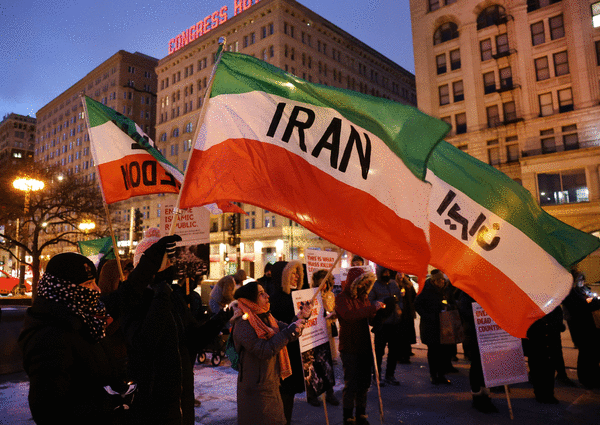
An additional rally broke out in downtown Chicago over the weekend after many Iranian-Americans learned of the death of Khamenei. While some residents celebrated in the streets for what they viewed as the end of an authoritarian dictatorship, others criticized what they believed was a misuse of power by President Trump.
“I think the American assessment was wrong, the assessment that if they decapitate the regime, everything would stop or change, or people could uphold the regime,” said Ali Tarokh, who lives in the far-North-side Chicago neighborhood of Rogers Park, near Evanston.
“They are very savvy, the Iranian regime.”
Tarokh said it’s been difficult to contact his family members and friends in Iran since the start of the attacks over the weekend.
He was able to reach his mother by phone shortly following the death of Khamenei on Saturday to confirm the reports she was hearing were true, but he hasn’t since been able to reach her or anyone else back home.
“I cannot even imagine my friends, my family getting killed by this war,” said Tarokh, who currently works as an adjunct professor of social welfare policy at Loyola University of Chicago.
“The entire country… is under attack now and nobody is safe.”
Tarokh immigrated to the United States over 13 years ago and became a naturalized citizen in 2018. He said the Iranian people have learned to navigate sustained conflict and diaspora for decades, living under an “absolute dictatorship” that arose following the 1979 Iranian Revolution.
But the people of Iran have, for more than 100 years, he said, continued to work towards a democracy, often at the expense of civilian lives.
“So many generations, so many people have worked so hard to build a democracy in our country…there are so many challenges, difficulties, and many people pay with their lives for that transition,” Tarokh said. “The question is for President Trump — Iran’s regime didn’t really (pose) a direct threat to the United States. [This] is a war of choice.”
“Regardless of if you are a Republican or a Democrat, nobody wants this war,” Tarokh added, “even his supporters, right? They voted for him because they didn’t want to go through another forever war.”
William Reno, professor and chair of the political science department at Northwestern University in Evanston, said dragging out the conflict into a long-term war may be advantageous for Iran.
“If you’re weaker, then the only way you can beat the strong is, you have to figure out what you have that they don’t have, one of which, in Iran’s case, is time,” Reno said.
“If Iran can survive the current regime, it wins by surviving. Whereas the United States, because it’s a foreign war… it becomes more and more of a political liability.”
Reno said the country’s frame of thinking is likely that if the United States is still engaged in a military conflict two or three months down the road, when the American electoral calendar is approaching, then it starts “looking really bad domestically.” But Reno said it’s still early in the process to make predictions.
“Maybe it turns out to be like Venezuela…get rid of the leader, somebody else pops up that [says] we’ll do what you want in international politics, and leave us alone for our domestic. We could, but we’re not seeing it yet.”
A spokesperson for the Chicago Persian School, a non-profit educational center offering language classes to students in the area wanting to learn Farsi, the Persian language, said the community was facing “intense and uncertain times” marked by emotions that range from “high hopes to anxiety and concern for loved ones.”
Because the institution self-identifies as a “non-political, non-religious non-profit,” Chicago Persian School declined to comment on the war itself or its impact on Iranian-Americans, who sometimes refer to themselves as Persian-Americans.
“At this time, our focus remains on supporting our students and their families by providing stability, cultural connection and a welcoming educational environment,” the spokesperson said.
While the Trump administration has consistently sought to pressure countries aligned with U.S. rivals to reorient themselves towards Washington, the end result has often led to greater instability, and in some cases, more lives lost.
“All conflicts are different” Reno said, “We’ll see how [this] works out.”
____
©2026 Chicago Tribune. Visit at chicagotribune.com. Distributed by Tribune Content Agency, LLC.




Comments