'A long way from finished.' GOP budget proposal passes Kentucky House
Published in News & Features
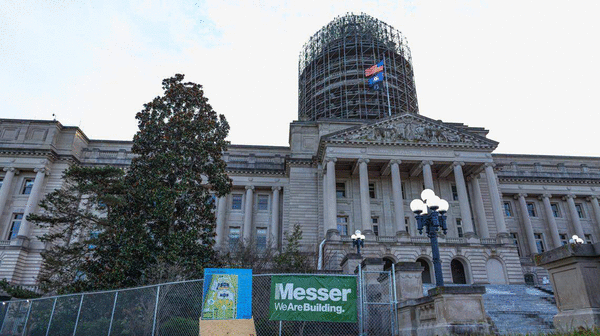
The Kentucky House’s version of the next state two-year executive branch budget bill — the most-watched piece of legislation this session — is heading to the Senate.
House Bill 500, spearheaded by House Republicans, passed out of the chamber Thursday afternoon after more than two hours of debate on an 81-18 vote. The 18 no votes were all from Democrats, with only Rep. Tina Bojanowski and Rep. Ashley Tackett Laferty crossing party lines to vote with Republicans.
The budget, which is passed every two years, funds spending for all facets of the executive branch for the next two fiscal years, which begin July 1, 2026. In the House’s version, lawmakers allocate nearly $31 billion — about $1.17 billion more than the first draft, which was about $29.81 billion from the General Fund.
The House’s passage is just the beginning of the long process though, and the document is still expected to change as it moves through the Senate.
The two bodies will then have to reconcile any changes before it is sent to the governor.
“From the start, we said this bill would substantially change and it has. Our subcommittees and staff were able to gather enough information from stakeholders to craft this version,” Petrie said in a news release. “As a result, this committee substitute intentionally allocates taxpayer resources in a way that preserves and strengthens essential public services without overextending government.
“We’re still a long way from finished with the budget process, but this is a strong next step.”
When HB 500 was initially filed, Democrats and others raised concerns over education funding and language that could have led to a loss of benefits for the Kentucky Employee Health Insurance plan members.
The committee substitute that passed out of the House Appropriations and Revenue Committee Wednesday afternoon and then on the floor addressed some of those apprehensions, including nixing the 5% increase cap on employer health plan contributions per year. That cap, Personnel Cabinet Secretary Mary Elizabeth Bailey wrote in a letter to lawmakers, would have caused a shortfall and led to increased premiums or a decrease in benefits.
While the first draft froze per pupil spending at $4,586 per fiscal year, the new version increases spending to $4,626 for fiscal year 2026-2027 and $4,792 for fiscal year 2027-2028. The Support Education Excellence in Kentucky formula, or SEEK, is a state-provided funding approach for schools based on per-student calculations.
Transportation funding was also raised to $399 million per fiscal year compared to the $359 million from the first draft, which was a $40 million decrease from current level spending.
Still, Democrats criticized the GOP proposal over a lack of funding for rural hospitals and housing, teacher raises and Gov. Andy Beshear’s pre-K for all program pitch.
Multiple Democrats filed floor amendments and motioned to suspend the rules to vote on them during debate. Language in the amendments would have included teacher raises, investments into pre-K expansion and millions of dollars into Kentucky’s Affordable Housing Trust Fund and the state’s rural hospital fund.
None of them reached the threshold for consideration on the floor. Floor amendments to appropriations or revenue bills must be filed 24 hours and available for public view before the House can consider them.
But with HB 500 being brought and voted on the floor less than 24 hours after passing committee, the floor amendments Democrats filed ahead of the debate were considered out of order and wouldn’t be able to be taken up for consideration unless the rules were suspended.
Many Democrats said they want to be part of the budget-crafting process and have felt left out so far.
“We want to be part of the process, and I hope that no one ever thinks that we don’t,” House Minority Caucus Chair Lindsey Burke said. “We reach out individually, collectively, and ask for a seat at the table. And I’m asking now that you think about what it means to allow us to have a meaningful seat at the table.”
GOP Rep. Josh Bray took issue with Democrats’ comments and said the House Appropriations and Revenue Committee has never turned down a meeting with a legislator. He co-vice chairs that committee alongside GOP Rep. Adam Bowling.
Bray said that he had zero conversations with Democrats on the floor amendments that they filed.
“You act like you’re doing something, but when it comes time to work, nobody ever asks,” Bray said. “So you can have your press conferences, you can file your amendments, but do the work.”
He also added while Republicans want to see more in education, Medicaid and public university funding, Kentucky has to “live within our means.”
“When we add up all these floor amendments here, there’s a lot more than we can afford to pay for,” Bray said. “So, file your floor amendments. But guess what? Maybe come have a conversation with us.”
Republicans gave Bray a standing ovation after his speech.
House Minority Leader Pamela Stevenson, a Democrat, said the Democratic Caucus has followed the rules and participated and believed Republicans’ frustrations with the party were misguided.
“What’s frustrating is because you’re mad and ranting about the governor... it doesn’t give you the right to be rude to your colleagues.,” Stevenson said. “Being big mad at the governor doesn’t give you the right to not house the homeless. It doesn’t give you the right to not feed children. It doesn’t give you the right to not give people health care because they need it.”
Throughout the budget process, Republicans have gone back and forth with Democratic Gov. Andy Beshear over access to information that lawmakers believe they need to help craft the budget. Earlier this week, co-chairs of the Legislative Oversight and Investigations Committee issued subpoenas Kentucky state budget director, secretary of the Personnel Cabinet and deputy secretary of the Personnel Cabinet for that information.
A spokesperson for Beshear called the subpoenas “a stunt with no merit.”
Before the House voted on HB 500, Beshear brought up concerns over the new bill during his weekly Team Kentucky update. He said if the budget doesn’t change, it could harm many programs and entities, including Medicaid.
“The House budget has $1.4 billion less for Medicaid than the projection,” Beshear said. “What will that do? It’s going to hammer rural and urban health care.”
During debate, Democrats questioned language regarding a transfer from the Insurance Regulatory Trust Fund to the Budget Reserve Trust Fund.
The Insurance Regulatory Trust Fund is a self-funded regulatory pool meant to support Department of Insurance operations and regulatory oversight. Language in HB 500 would direct $350 million of that fund to the Budget Reserve Trust Fund. Of that $350 million, $250 million is set aside to potentially cover Medicaid benefit payments.
“It is the intent of the 2026 General Assembly to reserve $250,000,000 for potential appropriation for Medicaid Benefits in the 2027 Regular Session if deemed necessary for claims payments in fiscal year 2026-2027 or fiscal year 2027-2028,” the language reads.
Critics though believe that move could be the prospect of a new cut to the state tax on personal income. The GOP-led legislature has put the state on a path to erase the tax completely, and the size of the Budget Reserve Trust Fund is one of the “triggers” that would allow them to cut it again.
HB 500 isn’t the only highly-anticipated budget bill.
Like in the 2024 budget cycle, there will be a separate bill that will originate in the House with onetime spending is expected at a later date.
©2026 Lexington Herald-Leader. Visit kentucky.com. Distributed by Tribune Content Agency, LLC.





Comments