As Cuba's energy crisis rages, US will let island's private sector import fuel
Published in News & Features
Amid a devastating energy and humanitarian crisis in Cuba worsened by U.S. oil supply restrictions, the Trump administration is planning to expand ability of the island’s private sector to import U.S. fuel.
“We want to open the spigot of U.S. fuel exports to Cuba, so long as the ultimate beneficiary is the private sector,” a source with knowledge of the plan told the Miami Herald. The departments of Treasury and Commerce will soon issue the new guidance, making clear there are no quantity limits for the oil exports.
For the past 60 years, Cuba has been dependent for oil imports from, first, the Soviet Union, and later from Venezuela. But the Trump administration has stopped oil shipments from Venezuela and Mexico to Cuba and has started conversations with Raúl Castro’s grandson, Raúl Guillermo Rodríguez Castro, to negotiate economic and political changes on the island.
“There is nothing more in line with the Donroe Doctrine than making Cuba dependent on the United States,” the source said, in reference to the president’s new take on the Monroe Doctrine that seeks U.S. economic and political dominance in the Western Hemisphere.
An inventive solution
Cuba’s private sector, often vilified by the regime, has already been circumventing the government’s fuel monopoly and buying diesel from the U.S., a small-scale but critical solution to alleviate food shortages and sustain private businesses on the island.
As fuel runs out, forcing private businesses to shut down operations and lay off their employees, a group of Cubans and Cuban Americans who own businesses in Cuba or export to the island has found a partial, but inventive solution: they are buying diesel in the United States and shipping it in special containers — called ISO tanks —to Cuba.
“If two Cubans in Miami are getting together, they are talking about the ISO tanks,” a Cuban-American lawyer told the Herald. Several sources who spoke to the Herald – including private business owners in Cuba, Cuban Americans with licenses to export to Cuba, and two Miami-based lawyers involved in the purchase of the diesel – asked to remain anonymous to discuss the business transactions.
ISO tanks are cylindrical, stainless-steel insulated containers that can carry gases and liquids, including fuel. They offer a small-scale solution, in contrast to an oil tanker, to transport diesel to the island using a regular cargo-container-sized shipping vessel. A standard 20-foot ISO tank container can transport up to 6,900 gallons of diesel fuel.
Diesel is the fuel used by the trucks owned or hired by private companies in Cuba to transport food and other supplies from the Port of Mariel in Havana to their warehouses, and then to other private businesses, such as restaurants and small grocery stores around the country.
While Trump has halted oil supplies to Cuba as leverage to press Cuban leaders to sit at the negotiating table, Secretary of State Marco Rubio has also suggested that the administration does not want to see the country collapse. He has authorized $9 million in humanitarian assistance to Cuba, which has been distributed through the Catholic Church and the Catholic relief agency Caritas in eastern Cuba.
But without diesel, even U.S. humanitarian efforts will be interrupted.
“That is where the private sector plays a key role and is a natural partner for the United States,” said Ricardo Herrero, the executive director of the Washington-based Cuba Study Group. “I think the Trump administration is coming around to seeing this, the role the private sector can play in building an alternative economy to that which has been all along dominated by the GAESA and state-run enterprises.” GAESA is the military-run umbrella group that controls much of the Cuban economy.
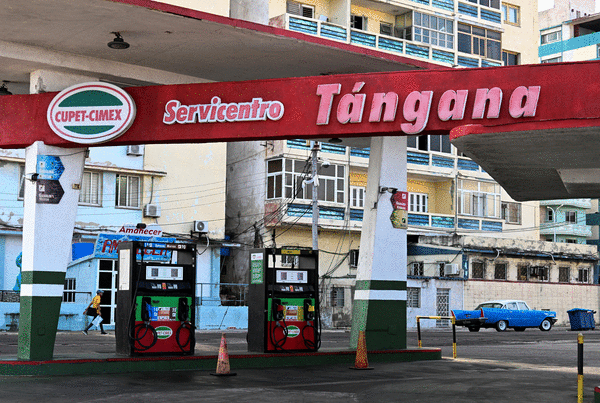
CIMEX, a military enterprise that is part of GAESA, controls all gas stations in Cuba. The export of oil to a private Cuban company has not been tested before. Sources say there are currently very few American companies with export licenses to export fuel to Cuba.
A win-win scenario
The two lawyers who spoke to the Herald believe those transactions do not violate the current U.S. embargo, as long as the American exporter has a valid Treasury Department license that allows them to export fuel to Cuba if the beneficiary is the private sector. The administration is planning to make that clear in issuing new regulations.
Allowing this model to “scale up,” one of the Cuban private business owners said, would be a win-win scenario: It would allow the private sector to continue distributing and selling food, strengthen its independence from the government, and break the government’s monopoly on oil.
Under pressure, Cuban government import-export agencies had privately told Cuban entrepreneurs that they would be allowed to import fuel, a recent development first reported by U.S. government outlet Martí Noticias. For now, Cuban authorities would only allow private businesses to buy fuel to sustain their business operations, not for resale. But if U.S. fuel exports grow, resale is likely to happen at some point, the people interviewed by the Herald said.
Asked if they believe the government would prevent the oil from flowing to the private sector, they said they did not think Cuban authorities would interfere.
“It’s like what happened with chicken. The minute they confiscate a container with chicken, there won’t be more chicken entering the market. The same will happen with the ISO tanks,” a Cuban private business owner who has purchased diesel and shipped it in an ISO tank to Cuba told the Herald.
‘People are going to die’
Right now, efforts to buy diesel in the U.S. bound for Cuba are at a very small scale, but the situation on the island is getting worse by the minute.
“I need the oil tomorrow,” the Cuban private business owner said. “I already had to close my business until I get the fuel, and a lot of other businesses are closing too.”
Another Cuban private entrepreneur told the Herald that the fuel shortages have led to few tourists visiting the person’s private restaurant. Several international airlines suspended flights to the island after Cuba said it had run out of jet fuel. “All the tourist groups I had booked had canceled. I will have to close and lay off 30 employees,” the business owner said.
Several participants in a Cuba Study Group event in Miami last week spoke of the urgency of finding solutions to a humanitarian crisis that was already taking place when U.S. warships in the Caribbean first started blocking oil shipments from Venezuela to Cuba in December. Then, in January, Mexico halted oil shipments to Cuba as well under threats of tariffs from the Trump administration.
Small private grocery stores around Havana are still stocked, “but as soon as there’s a lack of fuel, how are they going to keep their lights on and refrigerators going? Even if they have generators, without fuel or diesel, you can’t keep them going,” said Katrin Hansing, a professor of anthropology at City University in New York who recently traveled to Havana.
Hansing has done extensive research on poverty and inequality in Cuba and is sounding the alarm about the situation on the ground.
“There is a humanitarian crisis already happening; it has been worsening over the last five years,” she said. “The most pressing situation right now is that if the oil reserves run out and no oil shipments enter Cuba, the situation could become very difficult for everybody very quickly and potentially dramatic. The lack of fuel has already made people suffer enormously and if this continues people are going to die.”
One way to “unlock” the potential of the private sector to help at this difficult time, Herrero said, would be for the Trump administration to issue more specific licenses for companies to export diesel to Cuba, or issue a blanket authorization, called a general license, so that any American company that has the ability to export diesel to private businesses in Cuba is able to do so.
He also suggested the administration could issue so-called safe-harbor provisions and due diligence standards for U.S. banks so they would start opening bank accounts for private entrepreneurs in Cuba, which was authorized by the Biden administration. Banks have been reluctant to do so because of the lack of clear guidance and liability protections.
“With the support of the United States, you can see supply chains run by the private sector scale up dramatically,” he added.
Currently, very few American companies have export licenses that would allow them to send oil to the private sector on the island. A lawyer currently advising an American exporter trying to buy diesel to export to Cuba said the whole process is slow and cumbersome.
The lawyer said he had been spent most of his day on the phone, convincing everyone involved in the sale, loading and shipping of the fuel that they were not violating U.S. sanctions. That includes the entire business chain: the American oil company selling diesel to the American company with a license to export to Cuba, the company leasing the ISO tanks, the one pumping diesel into the tanks, the shipping company, and several companies providing insurance.
By the time he spoke to the Herald, he had yet to close the deal.
The controversy around ‘mipymes’
Cuba’s private sector has a bad reputation in Miami, where many local politicians and activists have insisted that most businesses are really connected to the Cuban government or are owned by members of the elite in power. Citing the export of a Lamborghini and jacuzzis to the island, three members of Congress from Miami and other local officials recently asked the administration to review all export licenses to Cuba and cancel those benefiting the Cuban government.
It is no secret that some members of the Castro family and relatives of government officials have also set up private businesses, known as mipymes, the Spanish acronym for micro, small and medium enterprises. That includes one son of Col. Alejandro Castro Espín, Raúl Castro’s son, and a son of the current minister of construction, René Mesa Villafaña, a Herald source with knowledge of their companies said.
But that’s not the full story, Cuban private entrepreneurs stressed.
“Of around a thousand businesses for which I have provided guidance, perhaps 40 had those ties with the government,” said one entrepreneur in Cuba who owns a consulting business.
More crucially for the island's future is that Cuba’s private sector has also relentlessly eroded the control that Cuba’s military conglomerate GAESA holds over the country’s economy.
In 2025, Cuba’s private sector imported over $2 billion in food and other supplies, making it the country’s largest importer of basic food staples such as chicken.
“The private sector is the only way you can get anything done,” said the Cuban entrepreneur who has already bought one ISO tank loaded with diesel. “It’s true there are front men, that the government uses certain specific people as pawns. All of that exists, but it’s not what defines the private sector.”
______
©2026 Miami Herald. Visit miamiherald.com. Distributed by Tribune Content Agency, LLC.





Comments