Washington Senate leaders propose $1.5 billion for transportation work
Published in News & Features
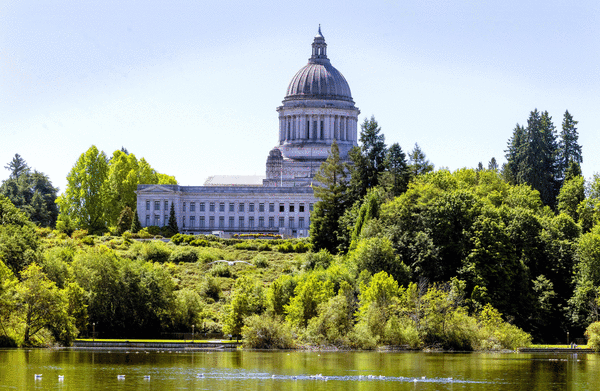
SEATTLE — The state Senate's top Democratic and Republican transportation leaders joined hands Monday to propose $1.5 billion in new spending, mainly for safety and maintenance.
State Sens. Marko Liias, D-Edmonds, and Curtis King, R-Yakima, described the work as necessary, and stressed that their proposed transportation budget could create tens of thousands of jobs.
I'm proud to tell you this is a bipartisan budget," King said, noting that he hadn't yet polled his caucus on their support, but said the fact that it doesn't increase taxes will "win some votes. I don't know why it wouldn't."
Overall, the Senate proposal accounts for transportation spending through 2031 and touches all corners of the state's transportation budget by focusing on preservation work on the state's highways, seeking more dollars by borrowing $1.1 billion through bonds and prodding the work to deliver new ferries with more money. At the same time, the proposal doesn't include spending for promised ferry conversions, and pushes other major projects farther down the road.
Most of the new money — $1.38 billion over six years — is slated for preservation work as well as projects aimed at recovering from December's destructive floods. The proposal has $525 million in new spending for highway maintenance for the two-year budget that ends mid-2027, including $40 million in unspent dollars from recent years that would be dedicated to flood recovery.
At a news conference, Liias said he was "confident and hopeful" the federal government will eventually help pay for that work, but the state couldn't wait to get the repairs done.
"Let's get the work done now," Liias said, "and then we can sort out [federal assistance] on the backside."
The proposal also increases spending on maintenance for the state ferry system by $100 million, money that would go to hiring more ferry workers; expand the maintenance facility on Bainbridge Island to deal with unexpected breakdowns; and upgrade the terminal in Fauntleroy to address traffic backups and vulnerability to earthquakes. Nearly $30 million more will go to buying new hybrid-electric vessels in an attempt to accelerate the delivery of two new boats by 2031, and $31 million toward electrifying the Seattle, Bainbridge and Clinton ferry terminals.
The budget assumes no other existing boats will be converted to hybrid-electric power until at least 2031, a delay that extends Gov. Bob Ferguson's decision to pause ferry conversion after the troubled work on the Wenatchee took twice as long as expected and at much greater cost.
While significant, the Senate proposal is just one step toward a final plan. The House will deliver its own transportation proposal, and legislative leaders will need to find points of compromise before the budget is sent to Ferguson for final approval. The 60-day session is scheduled to end March 12.
Liias acknowledged the Senate proposal sidestepped Ferguson's plan to borrow $1 billion for three new ferries, but said legislators will tackle that issue next year.
This budget amends the $15.5 billion plan approved last year.
The Washington State Patrol is on deck to get $2.7 million to fill vacancies in its ranks, which Liias and King said would help slow down drivers and make roads safer. Liias said WSP would be at full staffing "for the first time in a decade," a sentiment King echoed.
"I’ve been here 18 years and I can tell you the State Patrol has never even been close to where they need to be at, King said.
Though the proposal doesn't include new taxes, it taps into the state sales tax and allows $1.1 billion in bonds to be issued for highway projects. Even more bonding authority would be authorized for up to $400 million to cover unanticipated construction-related cost increases, and the proposal raises bond authorization by $500 million on the Highway 520 project to build and expand bridges over Lake Washington, Union Bay and Portage Bay in Seattle.
The proposal does not include any big cost increases to major highway projects, but does push back completion dates for some of the state's megaprojects, including the work to replace the Interstate 5 bridge over the Columbia River, the widening of Interstate 405 north of Bothell and the completion of the decades-in-progress north-south freeway in Spokane.
The plan also accounts for the 1.1% decrease in transportation revenue, about $101 million, projected in a forecast last week. That decline was softened some by the overall $1.8 billion increase in state revenue since November.
Other notable spending in the Senate proposal includes $30 million for electric vehicle charging station grants, the creation of a $1 million pedestrian safety grant program for cities to illuminate crosswalks and a revived plan from last session to spend $300,000 to connect Washington's cities in a network of bike trails.
©2026 The Seattle Times. Visit seattletimes.com. Distributed by Tribune Content Agency, LLC.






Comments