ICE data tells the story of almost 2,000 immigrant arrests in Washington state
Published in News & Features
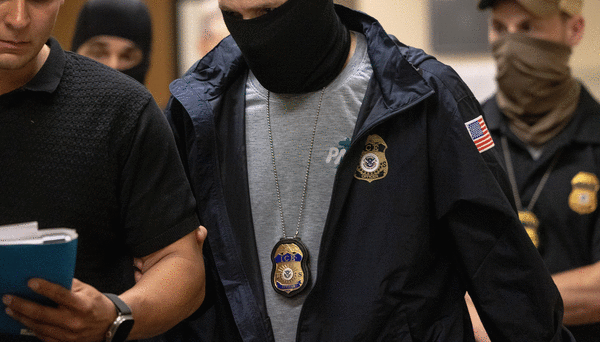
They were as young as 3 and as old as 71. A strikingly large share had neither criminal convictions nor pending charges against them in the U.S. Many would be forced out of the country.
These were the people taken into Immigration and Customs Enforcement custody last year in Washington state between the start of President Donald Trump's second term and Oct. 15, according to the authoritative Deportation Data Project. They reflect nearly 2,000 arrests.
That compares to roughly 50,000 in Texas, 21,000 in Florida and 18,000 in California during the same time period.
While there has been far less ICE activity here than in some other states, it has stepped up significantly from the previous year. Washington arrests under the Trump administration through mid-October represent a roughly 140% increase from the same time period in 2024. ICE made fewer than 1,000 arrests in Washington that entire year, the last under the Biden administration.
At a time when many Washingtonians are wondering whether a Minneapolis-style ICE crackdown is on the way, The Seattle Times analyzed the project's latest release of information to discern what we know about immigration enforcement in the state so far.
The project, based at the University of California, publishes ICE statistics it receives through Freedom of Information Act requests. Some of the data is inconsistent, missing or obviously wrong; one person arrested in 2023 supposedly left the U.S. 100 years before, in 1923.
The data doesn't cover the last four months, when ICE dramatically stepped up its activity in Minneapolis and possibly elsewhere. It also does not include people arrested by U.S. Customs and Border Protection. ICE is responsible for interior immigration enforcement while the CBP, including the Border Patrol, is charged with enforcement at or near borders.
Still, the project offers arguably the most comprehensive and transparent look at interior immigration enforcement as ICE's escalating show of force sparks controversy in Congress and around the country.
Washington has one of the highest rates across the country of people arrested without a criminal conviction or pending charges in the U.S.: 47%. One reason is a state law that prevents local jails from transferring people they release to ICE custody, although the state Department of Corrections can release people convicted of crimes from its prisons to ICE.
The arrest pattern makes Washington one of the clearest examples that the federal agency isn't primarily going after the "worst of the worst," as the Trump administration has often claimed.
"There's no rhyme or reason, it feels like," said Malou Chávez, executive director of Northwest Immigrant Rights Project, of ICE arrests under Trump. ICE is detaining people with pending asylum applications and dates to appear in immigration court, she said. Agents are pulling them over in their cars or showing up at their homes.
The administration has pushed to detain and deport more of those arrested, rather than releasing them pending the outcome of their immigration case. The number arrested in Washington who have subsequently left the country, either by deportation or "voluntary departure" to avoid forced removal, has almost doubled under Trump through mid-October, to about 1,100 from the same time period in 2024.
Kids have been swept into all of this, as evident when ICE recently took into custody a 5-year-old in the Minneapolis area and an 11-year-old in Spokane. In Washington, ICE took 88 kids into custody between Jan. 20 and Oct. 15. Fifty-five were 10 and under.
"I don't know that they're necessarily going after children," Chávez said. ICE sometimes detains kids rather than separating them from a parent.
The Trump administration is not the first to take kids into ICE custody. The Biden administration did, too, with 35 kids detained by the agency in just one month, September 2023. After that month, the numbers under Biden subsequently declined.
We don't yet have data to quantify how immigration enforcement has fluctuated in Washington since October. Chávez said she's hearing more stories of arrests, but isn't sure whether that's because people are documenting them more.
ICE arrests, she said, "used to be a very private thing ... people would be embarrassed.
That may be changing as more community members are rallying behind those targeted by ICE, whether by filming arrests, blowing whistles or posting information on social media.
The Deportation Data Project has filed a lawsuit to get information on ICE activity after October, according to project co-director David Hausman. When it might come, he said, is frustratingly unpredictable.
_____
© 2026 The Seattle Times. Visit www.seattletimes.com. Distributed by Tribune Content Agency, LLC.






Comments