Gov. JB Pritzker expected to propose 'maintenance' Illinois budget, legislative leader says
Published in News & Features
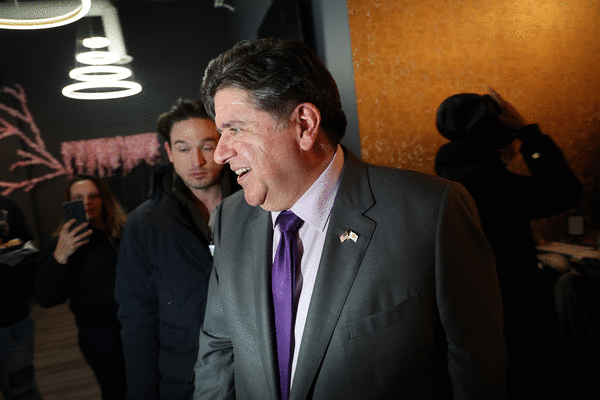
SPRINGFIELD — One day before Gov. JB Pritzker’s scheduled budget address, Illinois’ four top legislative leaders briefed on the plan Tuesday agreed it will have to hew to the line in a tight fiscal year, with one Democratic leader saying he doesn’t expect the governor to embrace calls by some progressive lawmakers to more aggressively tax Illinois’ highest earners.
“I’m expecting another responsible, balanced budget proposal from the governor. It’s, as I understand it, likely to be very much a maintenance budget. We’re living in uncertain times, and we don’t know tomorrow morning what tweet’s going to blow another hole in our budget,” Democratic Senate President Don Harmon of Oak Park said, referring to President Donald Trump’s penchant for policymaking via social media.
The legislative leaders met in the governor’s Springfield office. In addition to Harmon, the other three who attended were Democratic House Speaker Emanuel “Chris” Welch of Hillside, House Republican Leader Tony McCombie of Savanna and Senate GOP Leader John Curran of Downers Grove. They were mum on specifics and only received limited information about Pritzker’s budget proposal during the nearly hourlong Tuesday afternoon meeting.
Asked about the possibility of a proposal for raising taxes on the rich, Harmon said, “I don’t think the governor’s planning to propose any new taxes tomorrow.”
“I just have not heard any talk about the progressive revenue proposals,” he added. “I have not heard the governor talk about the progressive revenue proposals that are being circulated.”
Using Pritzker’s proposal from Wednesday as a baseline, the General Assembly will be tasked with negotiating a final budget by the end of May. Its Democratic leaders have stressed that cost-of-living issues are their focus, mirroring a broader national Democratic strategy ahead of the November midterms that seeks to blame rising prices from groceries to medicine squarely on Trump and congressional Republicans.
Pritzker is expected to deliver a speech that could highlight the nation’s political climate as much as the fiscal math affecting Illinois’ future. It will likely present a more optimistic picture of Illinois’ finances than last fall’s estimate that the state would face a $2.2 billion budget gap, and could also feature the governor going after Trump, who has emerged as Pritzker’s political archenemy.
Despite fiscal responsibility being a cornerstone of Pritzker’s political identity, the state’s $55 billion operating budget has grown by more than 40% since he became governor in 2019, though the increase equates to 11% when adjusted for recent high inflation.
A February report from Moody’s Analytics prepared for the legislature’s bipartisan Commission on Government Forecasting and Accountability found that Illinois’ economy weakened in the second half of 2025 and is projected to lag the Midwest and the nation in the year ahead. The report cited economic challenges, including “below-average population trends,” “deep-rooted fiscal problems such as mounting pension obligations” and a “shrinking tax base.”
But the immediate uncertainty about Illinois’ financial future stems from Washington, D.C., as the Moody’s report also warned Trump’s policies would act as “a net drag” on growth. Pritzker’s budget office has also warned that federal changes to Medicaid and the Supplemental Nutrition Assistance Program, stemming from Trump’s sweeping tax-cut-and-spending law from last year, could cause hundreds of thousands of Illinois residents to lose those benefits.
Meanwhile, Pritzker will face budgetary pressure from fellow Democrats, many of them progressive lawmakers, who have revived calls for a more aggressive overhaul of the tax system, including proposals to tax billionaire asset appreciation, levy a 10% tax on digital advertising revenue from large technology companies, prevent multinational corporations from shifting profits to tax havens and close certain corporate loopholes.
Public school advocates are also pressing for larger increases to the state’s evidence-based funding formula, known as EBF, which prioritizes funding for low-income districts. While the Pritzker administration has mostly pushed for the mandatory $350 million annual increase, some lawmakers say that hasn’t been enough, calling for increases of up to $1 billion.
Harmon said he expected a similar topline to the roughly $55 billion figure for the current budget year, along with a very small surplus under the governor’s proposal, but did not provide specifics when asked how the proposal could bridge the expected budget deficit.
Welch also declined to provide specifics on revenue proposals. “I don’t have any issues with what the governor’s going to present tomorrow,” he said.
McCombie was also generally tight-lipped about the budget discussions and said “uncertainty” was the word of the day. However, she said the topic of gambling was brought up.
“There were some conversations surrounding gaming but nothing specific,” McCombie said.
Curran said Pritzker “seems to be approaching it (the budget) with a bit of a sober lens.”
“I’m paying attention to really the nitty-gritty nuts and bolts of the budget speech, because this is going to be a tight budget in a tight budget year,” Curran said.
____
©2026 Chicago Tribune. Visit at chicagotribune.com. Distributed by Tribune Content Agency, LLC.






Comments