Senators press Lutnick over connections with Epstein
Published in News & Features
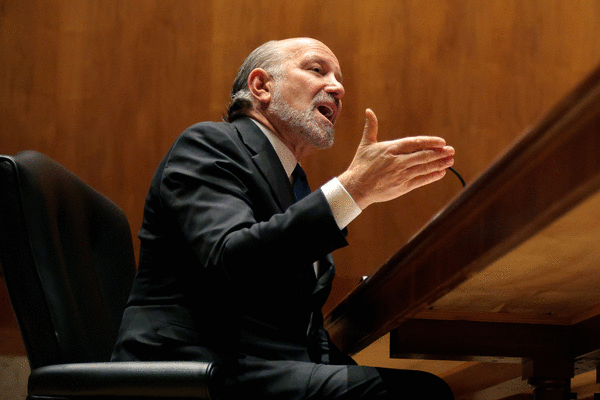
WASHINGTON — Commerce Secretary Howard Lutnick told senators Tuesday that “I have nothing to hide” in relation to his interactions with disgraced financier and convicted sex offender Jeffrey Epstein, in his first appearance before Congress since the emergence of new details about their communications.
At a Senate Commerce-Justice-Science Appropriations Subcommittee hearing on the federal broadband program known as BEAD, Democratic senators repeatedly pressed Lutnick about the times he met with Epstein and Lutnick’s past statements downplaying any involvement with him. The hearing came in the wake of the release of millions of pages related to Epstein late last month by the Justice Department to comply with the law enacted in November forcing disclosure of documents and investigative materials related to Epstein.
On an episode of the Pod Force One podcast in October, Lutnick said he visited his neighbor Epstein’s home once in 2005 and after questioning Epstein about a massage table in his home, Lutnick decided not to see Epstein again, calling him “disgusting.”
“I was never in the room with him socially, for business, or even philanthropy. If that guy was there, I wasn’t going, because he’s gross,” Lutnick said.
However, the new files showed interactions later than 2005, including after Epstein was convicted of soliciting prostitution from a minor in 2008.
The panel’s ranking member, Maryland Democratic Sen. Chris Van Hollen, said the changing story was a problem, even if Lutnick wasn’t accused of other wrongdoing.
“That does call into question your fitness for the job you now hold, and the question of your credibility before this committee and the Congress,” Van Hollen said.
Lutnick confirmed that he visited Epstein’s private island “for an hour” while on vacation with his family. He denied a separate incident of having dinner with Epstein and filmmaker Woody Allen but confirmed that he saw a document saying he met with Epstein for an hour in the evening.
Lutnick also said that, as far as he knows, his nanny didn’t meet Epstein and that he was surprised by mention of the request in the files.
“I looked through the millions of documents for my name, just like everybody else,” Lutnick said.
Sen. Chris Coons, D-Del., said the revelation of the further interactions “troubles” him.
“No, everyone isn’t worried about their names being in the Epstein files,” Coons said. “I know he was your neighbor. That was a coincidence, but please disclose everything that’s relevant here.”
Van Hollen asked Lutnick if he would share his own records related to Epstein. Lutnick said he would “talk about” the decision.
“I hadn’t thought about that,” he said. “I have nothing to hide.”
Sen. Jeff Merkley, D-Ore., urged Lutnick to clarify that he understands that his previous statement “might not have accurately portrayed” the extent of his relationship to Epstein.
“(I) just encourage you to be completely frank and open with everyone, correct the record as needed,” Merkley said.
Lutnick has faced calls to resign from both sides of the aisle, including from Reps. Thomas Massie, R-Ky., and Robert Garcia, D-Calif., who were co-sponsors of the Epstein files bill that became law.
Broadband concerns
Members of the committee from both parties also aired multiple concerns about the rollout of the $42.5 billion Broadband Equity, Access and Deployment program enacted by Congress to extend broadband access to rural and other underserved areas.
Last year, the Commerce Department’s National Telecommunications and Information Administration changed the program’s requirements, asking states to focus their proposals on the cheapest options to connect users. The program previously gave a preference to fiber optic cable broadband. The new proposals generally use less money and include a higher percentage of satellite internet than their predecessors.
Subcommittee Chair Jerry Moran, R-Kan., said he was “concerned” about placing emphasis on low cost rather than value.
“This approach risks repeating the errors of previous federal broadband deployment programs that fail to account for the unique connectivity needs in each of our states,” he said.
Moran pressed Lutnick on what would happen to $21 billion of funds left over after the approval of all final proposals.
Lutnick said NTIA plans to hold a listening session Wednesday to inform how the funds are spent but said only that the department doesn’t intend to try to rescind unspent funds to the Treasury.
“We’re listening to what are the best ideas to spend that money. We are going to spend that money, that money you have appropriated, and we’re going to use the best ideas,” Lutnick said.
Moran asked if the funds would be spent on broadband deployment. “The money will be spent according to the statute,” Lutnick said, going on to add that “we are going to hew exactly to the statute.”
Moran pointed to the last possible use of BEAD funds under the law, which reads, “any use determined necessary by the assistant secretary to facilitate the goals of the program.” He pressed Lutnick on whether soliciting new uses was intended to fall under that category.
Lutnick repeated his commitment to staying “within the statute” but said that only half the original appropriation was necessary to “give broadband internet connectivity to every single person that every state said was in need.”
Lutnick extolled the restructured BEAD program as saving taxpayers money.
Sen. John Kennedy, R-La., asked why all users couldn’t be connected with satellite internet if it saves money. Other senators rushed to clarify the nuances of the issue.
Sen. Jeanne Shaheen, D-N.H., said that satellite requires greater maintenance and has a shorter lifespan than fiber internet, which changes the cost calculus over time.
Sen. Shelley Moore Capito, R-W.Va., said that while satellite technology is progressing, it isn’t appropriate for every terrain.
“Does he have one mountain or valley in the state of Louisiana? I mean, you can, you can drive down the side of one of our mountains and totally lose any kind of line of sight on a satellite pretty quickly,” she said.
Capito also complained about delays to the BEAD program, including from restructuring under the Trump administration. “When you all then asked to have it rebid, it appeared like you were putting the slow tracks on it,” she said.
Sen. Lisa Murkowski, R-Alaska, emphasized that different states have different needs and that Alaska in particular has higher costs and a short construction season.
“We’ve never been the ‘benefit of the bargain’ in many cases, because we’re just so high-cost,” Murkowski said. “And it’s not because it’s waste, fraud or (abuse), it is just far out there.”
Lutnick committed that NTIA would approve Alaska’s proposal in time for construction to begin during the 2026 season.
Murkowski pressed Lutnick to commit that the “remaining funds be allocated in a way that are used to do exactly what we intended with this program, which is to strengthen ... all aspects of communication, particularly when it comes to our emergency or public safety communication in these rural areas where you just have these incredible gaps.”
©2026 CQ-Roll Call, Inc., All Rights Reserved. Visit cqrollcall.com. Distributed by Tribune Content Agency, LLC.






Comments