Laura Dogu, veteran US diplomat, takes on her most complex role as envoy to Venezuela
Published in News & Features
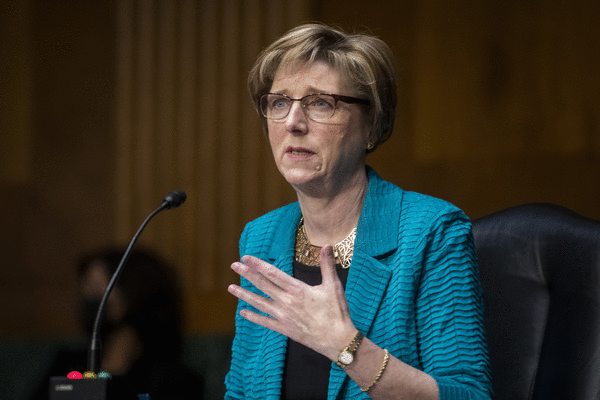
By the time Laura Farnsworth Dogu stepped onto the tarmac at Maiquetía International Airport near Caracas on Jan. 31, the assignment before her was already the most consequential of her career.
Tapped earlier this month by President Donald Trump as the United States’ lead diplomat to Venezuela, Dogu arrived in Caracas at a crucial political moment, following the capture of strongman Nicolás Maduro in a U.S. military operation, the installation of an interim government led by his vice president and close ally Delcy Rodríguez, and Washington’s push to reassert influence over a country whose oil wealth, institutions and foreign alliances have been reshaped by years of sanctions, repression and open hostility toward the United States.
For Dogu, a veteran diplomat with deep experience in Central America and a reputation for steady, process-driven diplomacy, Venezuela represents both familiar ground and an entirely new level of complexity.
“This is not a ceremonial posting,” said a former U.S. diplomat familiar with her career. “It’s crisis management, statecraft and economic strategy rolled into one.”
Frank Mora, a former Pentagon official who served as assistant secretary general of the Organization of American States and who has worked closely with Dogu for more than a decade, agrees.
“This is obviously not just a routine diplomatic appointment,” Mora said. “It reflects the administration’s priority in Latin America at a moment that is extremely complex, fluid and uncertain.”
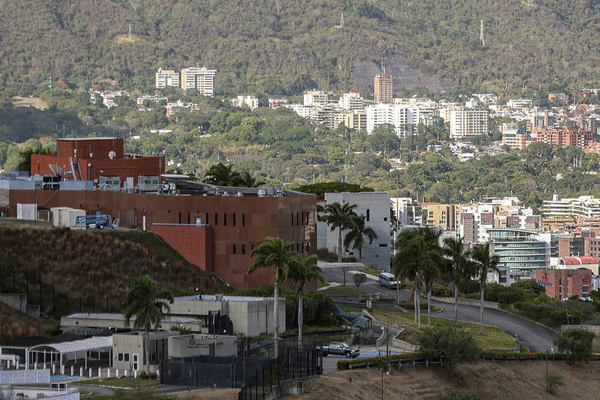
Dogu will be chargé d’affaires at the U.S. Embassy, a lower diplomatic title than that of ambassador. Her arrival also marks the formal reopening of the U.S. Embassy in Caracas, which had been shuttered for nearly seven years following a complete breakdown in diplomatic relations.
The embassy was closed in stages in early 2019 amid escalating tensions between Washington and Maduro’s government, after the United States recognized opposition leader Juan Guaidó as Venezuela’s interim president and ordered the departure of non-emergency personnel and family members. On March 11, 2019, then-Secretary of State Mike Pompeo announced the withdrawal of all remaining U.S. diplomats, citing deteriorating security conditions and the collapse of bilateral ties.
From that point until early 2026, U.S. engagement with Venezuela was managed remotely through the Venezuela Affairs Unit, based at the U.S. Embassy in Bogotá. The last U.S. ambassador to reside in Caracas was Patrick Duddy, whose tenure ended in July 2010; since then, Washington has relied on chargés d’affaires and, later, an ambassador-at-large operating outside the country.
Dogu’s return to Caracas on Jan. 31, restores a physical U.S. diplomatic presence for the first time in years, underscoring both the scale of the political rupture that preceded it and the high stakes of the experiment now underway.
A career forged under pressure
Raised in a military family, Dogu, 61, often traces her commitment to public service to her father, a career U.S. Navy officer whose assignments took the family across the country and overseas.
“Growing up, I learned firsthand about the value of serving your country,” she told the Senate Foreign Relations Committee in 2015. “My father spent a lifetime protecting America with tours of duty across the United States, abroad and at sea.”
That sense of mission carried her along an unconventional path into diplomacy. After earning a B.A. and B.B.A. from Southern Methodist University in 1985 and an M.B.A. in 1989, Dogu spent five years as a marketing representative at IBM before joining the U.S. Foreign Service in 1991.
Her early postings — as a consular officer in El Salvador, followed by consular and political assignments in Turkey — placed her at the intersection of migration, security and governance issues that came to define much of her career. Additional assignments followed in Egypt, Mexico and Washington, including a stint at the State Department’s operations center.
Mora first met Dogu when she was serving as a U.S. consul in northern Mexico during one of the most violent periods of cartel warfare in Ciudad Juárez, while he was working at the Pentagon.
“She was right in the middle of that violence in Juárez and northern Mexico,” Mora said. “Those were extremely difficult years.”
By the time President Barack Obama nominated her as ambassador to Nicaragua in 2015, Dogu was serving as deputy chief of mission at the U.S. Embassy in Mexico City, one of Washington’s most demanding diplomatic posts.
Latin America tenure
Confirmed unanimously by the Senate, Dogu arrived in Managua as relations between Washington and President Daniel Ortega’s government were deteriorating. In her confirmation testimony, she articulated a governing philosophy that has remained consistent: support for democratic institutions and human rights without imposing political systems from the outside.
Her tenure coincided with Ortega’s consolidation of power, the closure of civil society organizations and the erosion of political freedoms.
In 2021, President Joe Biden nominated Dogu as ambassador to Honduras, where she navigated corruption scandals, migration pressures and shifting regional alliances under President Xiomara Castro’s leftist government. Mora, then at the OAS, worked closely with her again.
“She’s very strong, very straightforward,” Mora said. “No nonsense. Straight to business.”
Those traits, supporters say, are precisely what Washington needs in Caracas.
“Ambassador Dogu has earned the confidence of Secretary Rubio and his team,” said Roger Noriega, a former assistant secretary of State for Western Hemisphere Affairs under George W. Bush. “She has a reputation for being clear-eyed and tough.”
Building the plane while flying it
After leaving Honduras in 2025, Dogu briefly stepped outside traditional diplomacy, serving as a foreign policy adviser to Gen. Dan Caine, chairman of the Joint Chiefs of Staff. The role deepened her exposure to defense planning and interagency coordination — experience now central to her Venezuela portfolio.
On Jan. 22, the Trump administration announced Dogu would become Washington’s top diplomat in Caracas. Her first high-level meeting came quickly: on Feb. 2, she met interim President Rodríguez at Miraflores Palace to discuss what both sides described as a new bilateral “work agenda.”
According to Mora, much of the ongoing dialogue between Washington and Caracas will now flow directly through Dogu.
“I think the conversation is going to be primarily between Delcy and Laura,” Mora said. “Washington or the secretary of state will step in depending on the issue, but the constant contact is going to be through her.”
That structure, however, carries risks.
“As we used to say at the Pentagon, we’re building the plane while flying it,” Mora said. “There is no established framework for this.”
Stability versus change
For Noriega, the central tension in Dogu’s assignment is not merely technical or diplomatic, but political — and potentially explosive.
“I can’t think of a more complicated assignment,” he said. “Her role is to manage the status quo while looking for the quickest path to democratic change.”
That balance, he argued, will be hard to maintain as Venezuelans grow impatient with interim authorities and look to a democratic transition.
“I think she will find that the people find Delcy intolerable,” Noriega said. “They want to run their own country.”
Noriega warned that prioritizing short-term stability could backfire if it reinforces structures Venezuelans associate with repression, amid concerns that the Trump administration is placing too much emphasis in opening the country’s oil industry to American companies and putting the process leading to a democratic transition on the back burner.
“Stability under an oppressive system is not a good thing,” he said. “Her team needs to tap into popular demands for real regime change without losing control of the process.”
That, he added, requires shifting power away from political figures and toward technocrats and institutional actors capable of governing during a transition.
“The key is steadily empowering technocrats who actually want to change things,” Noriega said, “and urgently identifying military officers who will protect the people, support a transition, and welcome new democratic leadership.”
An unprecedented experiment
Even with Maduro removed, Venezuela’s path out of crisis remains long and politically fragile. Institutions are hollowed out, the economy distorted and the oil sector severely degraded.
Mora describes the situation as an unprecedented experiment — one without a historical playbook.
“To my knowledge, there is no empirical case like this,” he said. “A powerful country trying to guide another country in this way — perhaps not since the early 20th century.”
There is no master plan, he said, and no agreed framework.
“Both sides are improvising,” Mora said. “They’re trying to figure out how each can achieve their interests, which in many respects are not the same. That’s the dance we’re in.”
For Dogu, the challenge will be to navigate that dance without becoming the face of Venezuela’s internal struggles — or the guarantor of an interim order that Venezuelans ultimately reject.
“Venezuela is orders of magnitude more complex than Honduras or Nicaragua,” said the former diplomat familiar with Dogu’s career. “But if you wanted someone who understands authoritarian systems, economic fragility and the limits of U.S. power, she’s a logical choice.”
©2026 Miami Herald. Visit at miamiherald.com. Distributed by Tribune Content Agency, LLC.






Comments