He fled Venezuela 20 years ago after defying Chávez. Now ICE wants to deport him
Published in News & Features
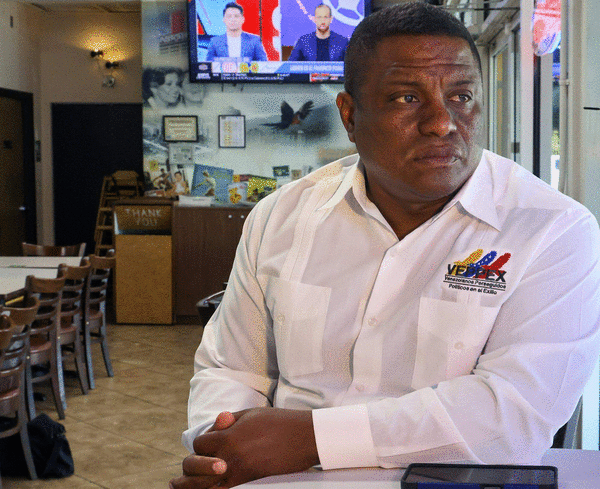
Germán Rodolfo Varela López was forced to flee Venezuela more than two decades ago after doing something that marked him for life: standing in public, in uniform, and denouncing President Hugo Chávez.
Now, after 20 years of living quietly in the United States, the former Venezuelan National Guard lieutenant faces deportation — which his family says could cost him his life.
Varela reported faithfully to U.S. immigration authorities, raised three children, built a business and stayed far from the politics that once forced him to flee his country. In 2005, a U.S. immigration judge ruled that returning him to Venezuela would likely result in torture or death, granting him protection under the United Nations Convention Against Torture.
Today, Varela sits in U.S. Immigration and Customs Enforcement custody in Tennessee, detained since November 2025 and facing possible deportation, maybe not to Venezuela, but to Mexico. His family and fellow Venezuelan exiles warn that such a move could place him in grave danger.
When judges grant protections under the Convention Against Torture, that typically prohibits deportation to the country where they could face danger. However, they can still be sent to third countries, lawyers told the Herald, and Mexico could eventually send Varela back to Venezuela.
“This is not a technical immigration issue,” said José Antonio Colina, president of the Venezuelan exile group Veppex. “It’s about whether the United States will uphold the protection it already granted against torture.”
A case rooted in dissent
Varela’s story begins in one of the most turbulent chapters of Venezuela’s modern history.
In 2002, he and Colina were young officers who joined the Plaza Altamira protests in Caracas, a rare public civic-military movement against Chávez. The officers accused the government of politicizing the armed forces and tolerating the presence of Colombian guerrilla groups and Cuban military personnel on Venezuelan soil.
By late 2003, both men were accused by the Chávez government of terrorism and faced arrest warrants and threats. On Dec. 19, 2003, they arrived at Miami International Airport and formally requested political asylum. They were detained at the Krome processing center near the Everglades, passed interviews showing they had credible fear of being persecuted if they were returned to their country — and then saw their cases against them in Venezuela escalate.
The Venezuelan government accused them of attacks on the Spanish embassy and Colombian consulate in February 2003. It filed an extradition request. In the course of over a dozen hearings before a federal judge, the allegations were examined but never substantiated.
In February 2005, their asylum petitions were denied, but the U.S. granted both men protections under the Convention Against Torture, finding that they would be tortured or killed if returned to Venezuela. After a hunger strike and further appeals, both were released in April 2006 under a high-control program for migrants who cannot be deported.
Colina settled in Miami. Varela moved to Memphis.
Two decades of compliance — then detention
According to his brother, Carlos Varela, Germán complied with every immigration requirement for the next two decades, reporting first monthly, then quarterly, then annually. He never had a criminal record and cooperated with U.S. authorities. A Miami Herald search of public records found only traffic infractions over his two plus-decades in the U.S.. He paid a fine for failing to stop at a red light in Florida, records show, and a judge withheld convictions in two 2011 speeding cases in Illinois.
That changed on Nov. 21, 2025, during what Carlos described as a routine immigration check-in in Tennessee. Varela was fitted with an ankle monitor and told to return the following week. When he did, ICE detained him, informing him that his Convention Against Torture protection could be reviewed.
Over the following weeks, Varela was told he would be removed from the United States to a third country — with Mexico emerging as the likely destination.
“From the first day, he said Mexico was the same as Venezuela,” Carlos said. “He told me, ‘I’m scared. I can’t sleep.’”
Mexico can be dangerous
On Friday, the first flight carrying deportees from the U.S. landed in Venezuela since U.S. forces captured leader strongman Nicolás Maduro. The United States had paused deportations to Venezuela for a little over a month. The Trump administration sent Venezuelans to Mexico instead as part of its aggressive mass deportation agenda that is expanding third-country deportations.
Advocates supporting Venezuelan immigrants in Mexico, immigration attorneys in Miami, and Venezuelan dissidents in the United States emphasized that Mexico is not necessarily a safe third country for deportees.
Venezuelans are being dropped off in parts of southern Mexico where there is a large presence of organized and violent crime, said activists on the ground, and where there are fewer legal resources to help them legalize their status.
Varela could try to seek asylum in Mexico. But it’s also possible that Mexico could deport Varela and others fleeing political repression to Venezuela.
And even if Varela were to remain in Mexico, Colina and other exiles argue that networks linked to the Venezuelan regime — including figures associated with the Cartel of the Suns and transnational gangs such as Tren de Aragua — operate with enough reach to endanger former military opponents there.
In a letter sent this month to Secretary of State Marco Rubio, Colina urged immediate U.S. intervention, warning that deportations of CAT-protected Venezuelans to third countries like Mexico risk “chain refoulement” — indirect return to torture through intermediaries.
“CAT explicitly prohibits removals where there is a substantial risk of torture, whether by government agents or with their acquiescence,” Colina wrote. “That protection applies globally, not only to Venezuela.”
The letter highlights Varela’s case as nearly identical to Colina’s own: both entered the U.S. together in 2003, both were accused by the Chávez government of politically motivated crimes, and both were granted CAT protection after judges found a credible risk of torture.
Varela, Colina noted, has since lived openly in the United States and even contributed as a security analyst to Spanish-language media, including CNN en Español — visibility that exiles say increases his risk.
Appeal to Washington
Colina’s letter asks Rubio to promote an immediate moratorium on deportations to third countries for Venezuelans with CAT deferrals, particularly former military officers, and to urgently review Varela’s detention, including possible release under supervision or bond.
The appeal also cites Venezuela’s incomplete political transition: while Maduro has been captured and some Venezuelan political prisoners released, human rights groups such as Foro Penal report that hundreds of political and military detainees remain imprisoned in the South American nation, with repression continuing under figures like Interior Minister Diosdado Cabello and Defense Minister Vladimir Padrino López. And though the United States removed Maduro, his second in command, Vice President Delcy Rodriguez, is now at the helm of the Venezuelan government.
“This is not a post-dictatorship environment,” Colina said in an interview. “The structures of persecution are still there.”
Silence and fear
Carlos Varela said the last time he heard from his brother was the day before officials interviewed him again. Germán sounded panicked, he said. Since then, there has been silence.
Colina said detainees from Germán’s facility are often transferred during early morning hours — frequently to Mexico — heightening fears that removal could already be underway.
Compounding the concern are Varela’s health issues. He suffers from diabetes and hypertension, and his family says he has received inadequate medical care while detained. They have been unable to visit him or provide legal assistance. Shelter providers in Mexico who are receiving U.S. deportees say they have been overwhelmed by a wave of older immigrants who have chronic conditions, and they struggle to help them find care.
A test of U.S. commitments
Immigration experts say the case raises broader questions about the durability of protections granted under the Convention Against Torture.
“CAT is supposed to be one of the strongest safeguards in U.S. immigration law,” said a former immigration attorney familiar with similar cases, who requested anonymity. “Reopening those cases decades later — and deporting people to third countries with known risks — undermines that protection.”
Carlos Varela said that his brother believed the U.S. would honor his word and protect him from the government he stood up to over 20 years ago.
“We’re asking it to do that now — before it’s too late.”
_____
©2026 Miami Herald. Visit miamiherald.com. Distributed by Tribune Content Agency, LLC.





Comments