Will folic acid change the taste of California tortillas? Here's what to know
Published in News & Features
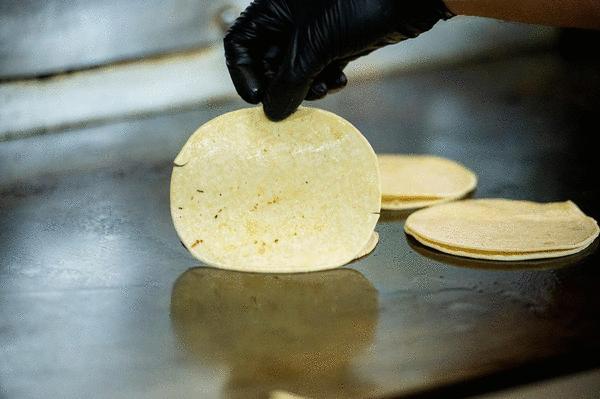
SACRAMENTO, Calif. — Since the beginning of the new year, California has implemented a new ingredient to tortillas that is expected to improve the health of generations moving forward.
In an active effort to reduce a gap in healthy births in the Latino community, the state is requiring tortilla producers to add folic acid to corn masa.
But what is folic acid, and what are the benefits of adding this ingredient to tortillas? Will it affect the flavor?
Here’s what to know:
What is Assembly Bill 1830?
The new California law or Assembly Bill 1830 requires most tortillas and corn masa products sold to contain folic acid, a vitamin important to infant health, according to CalMatters.
The law is based on the data gathered by Carolyn Subramaniam, UC Davis environmental policy and management graduate student. The data showed there’s a significant lack of folic acid in Latina diets compared to other demographics. But that disparity can lead to major birth defects.
The newly enacted law was authored by Assemblymember Joaquin Arambula, a Democrat and doctor from Fresno. His years in medicine had him witness the “worst health disparities within the Latino community” in a rural county, said Sana Jafery, his legislative director, in a phone interview.
Jafery said this additional ingredient in masa will make drastic improvements in the health of newborns with little changes in production and the lives of tortilla consumers.
“It’s how you meet people where they’re at. And it’s something that would be minimally disruptive to both the market and consumers at large,” Jafery said. “And it’s going to save up to 50 to 100 babies a year, once fully implemented.”
Moving forward folic acid will be added to corn masa flour at a level not exceeding 0.7 milligrams per pound of corn masa flour, according to the legislative summary.
The bill would exempt snack foods and corn masa flour made by, or supplied to, certain types of businesses including cottage food operations.
What is folic acid?
Folic acid is a synthetic form of the folate vitamin B9, which is particularly important during early pregnancy and prior to pregnancy.
It is the only form of folate that’s been shown to help prevent serious birth defects called neural tube defects. This type of birth defect can affect a baby’s brain, spine and spinal cord development and occur in the first month of early development, often before someone is aware of pregnancy, according to the Centers for Disease Control and a UC Davis policy brief.
Up to 70% of all neural tube birth defects can be prevented when people consume 400 micrograms of folic acid prior to conception, according to the California Department of Public Health.
What do tortillas have to do with health equity?
In 1998, the Federal Food and Drug Administration mandated folic acid fortification of all enriched cereal grain products including cereals, breads and pastas. Since the mandate, neural tube defects have dramatically declined in almost every single ethnic population except for Latinos, according to Jaffery.
Jaffery said that the Latino population relies heavily on corn masa products in their daily diet rather than flour and other grain products that are enriched with folic acid.
Despite incredible progress to reduce the neural tube defects, Hispanic and Latino communities still have an elevated risk of developing these defects.
Since the implementation of folic acid in enriched grains, the federal Food and Drug Administration has approved voluntary addition of folic acid to masa.
“While this policy affirms the safety of fortified masa, it is reliant on industry to take initiative,” according to the policy brief. “As a result, only 10% of masa products are fortified in the US. Low levels of market adoption require the FDA to pursue further action beyond voluntary fortification.”
Jaffery describes it as an unfortunate oversight and a prime example on the importance of having diverse voices at the table when making decisions.
Will folic acid affect the taste of tortillas?
No, it will not.
A number of tortilla producers have been putting folic acid in their tortillas since about 2016 and have noted no taste difference, said Jaffery.
Regardless, Jaffery shared that she and Arambula did a taste test of their own with sides and lightly toasted and found no difference in flavor.
“Why mess with a cultural staple that has been produced for thousands of years if it’s going to screw it all up?” Jaffery said. “I can confirm the taste is the same.”
____
©2026 The Sacramento Bee. Visit at sacbee.com. Distributed by Tribune Content Agency, LLC.






Comments