Venezuelans in Central Florida may have to return, sparking fear and mixed emotions
Published in News & Features
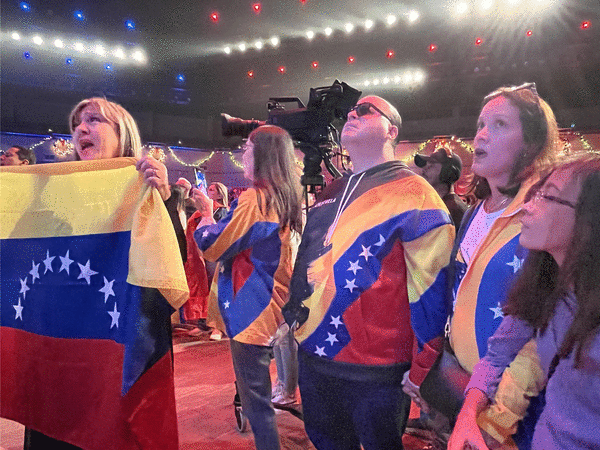
David Garcia, 34, arrived in the U.S. at the southern border seeking asylum four years ago after getting on the wrong side of the repressive Venezuelan administration.
Now, he fears retribution from that government if he returns — and it’s likely that he, and thousands of others, will soon be forced to do just that by the U.S. government.
“Prison time is waiting for me as soon as I step off the plane,” said Garcia, who asked the Orlando Sentinel to use only his middle and last name.
Over 600,000 Venezuelans have immigrated to the U.S. and many enjoyed protection against deportation through Temporary Protected Status until last year, when the Trump administration announced it would end the program.
But now, TPS refugees like Garcia are in an even more difficult limbo, receiving deeply mixed signals on whether it is safe to return to their homeland in the wake of the U.S. capture of President Nicolas Maduro, and whether this country might allow them to stay.
Venezuelans are one of Florida’s largest immigrant groups, and the majority of TPS recipients live in the state.
On Sunday during an interview on Fox News, Homeland Security Secretary Kristi Noem said Venezuela is “more free today than it was yesterday,” but then told TPS holders they could apply for asylum, a legal process for those who fear returning to their home country.
Complicating things further, all asylum applications are paused according to a December memo by U.S. Citizenship and Immigration Services.
On the ground in Venezuela, a state of emergency has been in place since the surprise U.S. raid that captured Maduro. Police have been ordered to “immediately begin the national search and capture of everyone involved in the promotion or support for the armed attack by the United States,” according to a text of the decree published on Monday.
Garcia had worked as a mechanical engineer in the oil industry until, he said, the administration turned on him after he protested one of thousands of oil spills. While working, he said he would be watched by a group of officials from the Venezuelan government, until one day it escalated to their paying a visit to his house. It was then when Garcia knew it was time to leave.
He and other refugees came to the U.S. “because we were the opposition group to Maduro’s regime, and we’re not yet at conditions that would allow us to return,” he said. “There will come a time when we will have to go back to reconstruct Venezuela … and bring our expertise that we’ve gained elsewhere back to our country, a country that really needs us.”
Last year, U.S. Rep. Darren Soto, D-Kissimmee, and three other Florida Congress members reintroduced the Venezuelan Adjustment Act, which would provide those in the country before 2021 a legal pathway to permanent residence.
Soto is also working on a letter to President Trump asking to reinstate TPS for Venezuelans through an executive order, arguing that the U.S. action in Venezuela has made the situation worse.
“Taking out Maduro was a good thing … but that really hasn’t improved the situation for the thousands of family members of my constituents who longer have TPS and can face deportation,” Soto said. “These bills are particularly relevant to trying to help them in the short run … because these folks can’t go home, it’s even more chaotic now.”
But Soto said the proposals are long shots. He said the administration did not make “any commitments” to bring back TPS or to grant Venezuelan refugees asylum.
During his first-ever hearing before an immigration judge in June, Garcia was arrested and detained. He was transported to the Krome immigration detention center outside Miami, then to one in Texas, then back and forth between Krome, a federal prison in Miami, other local county jails and another immigration detention center in north Florida.
Overall, he spent nearly four months in six immigration detention centers across the country.
The worst conditions were at the Glades County Detention Center in Florida, where Garcia said those held by ICE were housed alongside convicted criminals.
“I had to sleep next to someone who I found out was there for murder,” Garcia said. “I wish I hadn’t found that out because I could have slept so much better.”
Kissimmee-based immigration attorney Ingrid Morfa warned the “legal limbo” experienced by Garcia and other Venezuelans may only continue, as Maduro’s capture could make their asylum cases weaker.
“Now, adjudicating officers and judges will have more discretion based on what they believe is happening in Venezuela,” Morfa said. “I foresee a larger number of people being denied asylum claims … which will eventually result in more physical deportations from the country.”
Morfa said many of her Venezuelan clients have passport complications, either having their documents annulled by the Maduro administration, or expire, or get seized by ICE.
“Everyone’s panicking,” Morfa said of her Venezuelan clients. “I had a client that requested his passport months ago and today the client was supposed to go get it and then didn’t. He intended on leaving but he had a change of heart last night.”
William Diaz, founder of the nonprofit Casa de Venezuela, said Venezuelans have mixed emotions. Some are hopeful to return to the country they love, while others are skeptical if it can change. He said he believes there are many Venezuelans who will want to go back.
“It could be that the people who don’t have a clear future in terms of immigration will probably like to leave, leave right away, and the people that have some options will stay,” Diaz said.
Diaz said ousting Maduro is just the first step. He and his organization are beginning to work on a project that will recruit professionals across various industries who left Venezuela to return to the country and work to fix it.
Garcia is preparing for the possibility he may be forced to return. He was granted release from detention during the short window when federal judges issued rulings that blocked ICE from deporting Venezuelans with TPS such as himself.
But what he endured during his months-long stretch of detention centers has been traumatic, he said.
“The first week out I couldn’t leave my house because I was so paranoid that they were chasing me,” Garcia said.
He lost his job at Universal — after having been awarded the “employee of the year” — for failing to show up after he was arrested and detained, he said.
Now he has to restart his life as if he was just entering the U.S. all over again.
“You are left destroyed,” Garcia said.
_____
©2026 Orlando Sentinel. Visit orlandosentinel.com. Distributed by Tribune Content Agency, LLC.




Comments