Aldermen's historic Chicago budget now reality, but may not be finished product
Published in News & Features
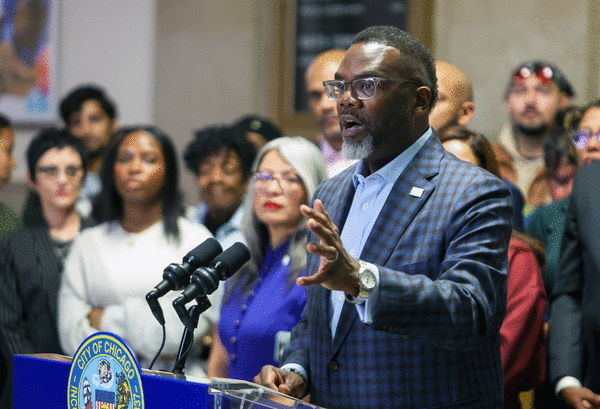
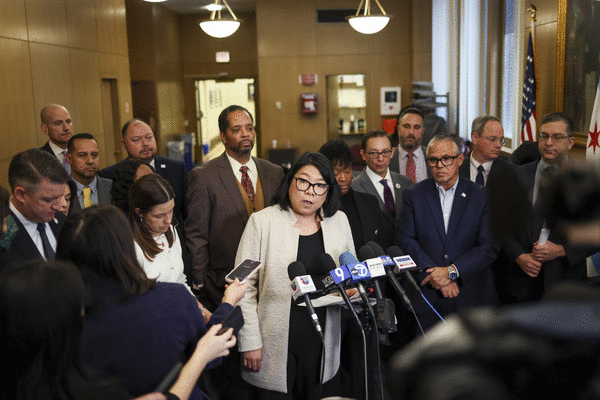


CHICAGO — For decades, strong Chicago mayors told acquiescent aldermen here’s the budget, take it or leave it, secure in the knowledge they had the votes to pass basically whatever they wanted.
The message has long been “trust me, it’s great,” Ald. Nicole Lee said.
But the City Council gave a new reply this year when Mayor Brandon Johnson put forward his plan, “Locking arms and jumping off the edge together,” Lee said.
Where they landed is now Chicago history: The council majority wrested power from the mayor to close the budget gap with a final batch of new spending, cuts and taxes of its own design.
That revolt locked in critical changes to city policy, many made with little public discussion. The new version largely replaced Johnson’s plans to install a corporate head tax and halve a planned advanced pension payment.
Aldermen legalized video gambling machines in neighborhood establishments, restructured liquor taxes to bring in more revenue, cleared the way for advertising on downtown bridges and more.
The quick, dramatic shift has left many questions unanswered. Top among them: Did aldermen pass a budget that is truly more sustainable or only more politically palatable?
Just before the Christmas holiday, Johnson opted against a veto but cried foul.
“They stuck something in the budget within a week and then asked people to vote on it,” Johnson said. “The people of this city did not get a full chance to get a full read on what was being proposed.”
The projections aldermen made for their policy changes are often bold, but not necessarily implausible, civic analysts told the Tribune. And while the winning counterproposal makes some key changes favorable to credit rating agencies, it also clings to entrenched practices that continue to make Chicago appear a risky investment, they said.
“It’s fair to criticize this overall plan to say, ‘OK, yeah, in a perfect world, we would have actual budget analysis of these things,” said Justin Marlowe, director of the Center for Municipal Finance at the University of Chicago.
Still, the numbers underlying the plan are believable, Marlowe said.
The $89.6 million aldermen plan to bring in by selling $1 billion in debt is “probably in the ballpark of what’s possible” and “a thing that cities do,” he said.
Johnson has warned the move is financially risky and likely to lead poor Chicagoans to be targeted with aggressive debt collection, an equity issue Marlowe acknowledged. The mayor’s own team has reportedly considered a similar debt sale, but deemed its prospects uncertain.
Marlowe similarly believes there are enough “efficiencies” to save the city an estimated $46.6 million, while noting some are sure to involve heated negotiations with labor groups that will take “some time.”
A shift in alcohol taxes from volume-based to price-based is hard to predict, he conceded. Aldermen say it will raise another $6 million, while Johnson’s team anticipates it losing the city money.
A similarly sharp loss-or-gain debate surrounds the legalization of video gambling terminals. Critics warn it could cannibalize higher-yield casino revenues, would assuredly cost Chicago a $4 million annual payment from Bally’s, and would not be quick to get up and running thanks to licensing lag at the state.
City Council members project the state to approve gambling machines at 1,800 Chicago locations this year. They are also assuming operators would start receiving licenses to work in the so-far undefined system by July.
The state licensed 790 last year outside Chicago and is currently vetting 480 more establishments, according to the Illinois Gaming Board.
Aldermen are also counting on $29.3 million to come in from selling advertisements on bridge houses, light posts and city vehicles, which Marlowe said is “not unrealistic.”
“The question is does it create enough backlash because people see it as crass commercialism,” he said.
Ralph Martire, executive director of the Center for Tax and Budget Accountability, was less optimistic. He questioned whether the city will be able to sell off the 10-figure sum of debt, “sort of a novel thing,” and described the addition of video gambling as “certainly regressive.”
The success of the advertising plan — which failed under past mayors — is similarly difficult to predict, Martire added, and he said he believes Johnson’s budget analysts are right to think the liquor tax change could cost the city money.
If the numbers are off, the city will be forced to take cost-cutting measures later this year or face an even bigger hole next year.
“Ensuring whatever assumptions they made is crucial,” Martire said. Still, he praised the alternative group’s efforts as “good grounds for an adult discussion” that is better than the traditional “budget by executive fiat.”
“You clearly have aldermen taking the budget seriously and offering alternatives,” Martire said.
Aldermen becoming the budget decision-makers is only the latest product of a political sea change long in motion.
Lee was caught off guard by the final budget vote in 2024. She had hoped for more time, she said, and was surprised that Johnson could and did suddenly pass his spending plan. She recalled thinking aldermen should have been better organized.
This fall, she and other moderate aldermen did lock arms, leading a coalition that only grew as budget season wore on. The group remained notably disciplined in its narrow messaging and persistent criticism of Johnson.
Their effort also got support from groups funded by wealthy Chicagoans that bashed Johnson’s spending plan by bankrolling over $100,000 in Facebook ads and even more on television. Donors for one of the groups, Common Ground Collective, include investor Michael Sacks, a close adviser to former Mayor Rahm Emanuel. The groups squared off against efforts backing Johnson’s plan, including at least $80,000 spent by the Atlanta-based Black Voters Matter Fund on Facebook ads.
But they faced significant challenges. Unlike Johnson, aldermen did not have dozens of expert staff ready to flesh out budget ideas, and they faced a desperate time crunch as the mayor broadly refused their ultimatums and ideas.
The City Council-majority coalition said little about who helped craft those plans and projections. They cited support from civic leaders, high-ranking officials from past City Hall administrations and industry experts, but did not name the individuals who contributed to their analysis.
The final product was “as good as it could be for the moment that we are in,” Lee said. “I think that what we fought hard for, small as it was, was something that’s going to make a big difference down the road.”
Debt buyers and ratings agencies alike care what kinds of revenue the city is counting on, to what extent one-time fixes close a significant part of the annual deficit, and whether new taxes and fees stunt growth. They also pay close attention to how the city is tackling its pension liabilities. A downgrade from those agencies — or disinterest from investors — could prove costly.
Ratings agency S&P changed the city’s outlook to “negative” in early November, warning a downgrade could come if Chicago fails to “implement structural budget adjustments that place it on a more sustainable operating trajectory,” ensure the pension gap does not grow and keep outyear deficits manageable. The city could improve its outlook if it substantially reduced “its chronic reliance on short-term budgetary fixes,” and stabilized pension funding levels.
Stabilizing pensions — one of the strongest headwinds facing Johnson and the council — will only get more difficult with pending changes for Tier II workers in Springfield and a recent boost to police pensions signed by Gov. JB Pritzker.
Alternate budget backers successfully pushed a fully funded pension advance. But they left untouched other deficit-plugging measures in Johnson’s plan frowned upon by budget watchdogs.
That includes the record $1 billion the city plans to take from special property tax districts to plug the 2026 budget hole. Long criticized by fiscal hawks and ratings agencies as a one-time fix, sweeping accrued money out of TIF districts has increasingly become a short-term lifeline for both the city and — especially this year — Chicago Public Schools.
Rich Ciccarone, a municipal bond analyst, warned in a December interview, “If you’ve gotten addicted to (TIF) to pay for operating expenditures — either of the city or the school district — there’s an ultimate day of reckoning” when the funds will be tapped. “That’s worrisome.”
Rather than annually surplusing property tax revenues from TIFs, a more steady and reliable income stream would be sunsetting TIF districts and extending the regular property tax levy to the homes and businesses inside them. But keeping any given TIF in place allows local aldermen and the mayor’s office to have their cake and eat it too: keeping some money for ribbon cuttings and infrastructure projects the money in the district helps pay for while retaining the ability to skim from the fund when budgets are tight.
Regular property taxes are considered more reliable because they are not as sensitive to economic swings as other major sources of cash. But increasing them is historically politically toxic and was essentially nuclear after this year’s tax bills landed in mid-November.
Aldermen did not want to add to the major hits that homeowners in South and West side neighborhoods saw on their bills. And they were reluctant to heap extra costs on downtown commercial buildings that typically shoulder a big tax burden but are still seeing high vacancy rates and getting sold for less than the purchase price a few years ago.
Raising the city’s garbage fee was another structural solution that aldermen and the mayor opted to avoid because of similar political difficulties.
The $9.50 rate has not gone up in nearly a decade, bringing in just $60 million, but the full cost of collecting garbage has risen to $320 million, according to the mayor’s budget working group. Despite some chatter about breaks for seniors and low-income Chicagoans, aldermen and the mayor ultimately decided a hike would be unsustainable for residents already facing this year’s record increase to property tax bills and rising everyday costs.
Aldermen briefly criticized Johnson’s plans to issue debt to pay for legal settlements and back pay for Chicago firefighters, but ended up allowing it. Borrowing for operating costs creates long-term debt for one-time expenses and signals to investors and ratings agencies that the city cannot live within its means. In this case, that borrowing will cost $52 million in interest.
Johnson’s team argued that both the settlements and back pay were “extraordinary” and that the debt would be paid off more quickly than similar scoop-and-toss maneuvers under their predecessors. The plan to monetize unpaid bills is also a one-shot solution, experts warned.
The mayor’s hiring freeze — expected to generate $50 million — is also nonstructural.
Aldermen had few questions about whether other efficiencies in Johnson’s budget were reliable. Efficiencies are a classic fallback, Martire said. He was skeptical they would come to pass. “I’m not saying smoke and mirrors, but a little wispy,” he told the Tribune.
It’s unclear how ratings agencies and debt buyers view the hodgepodge of revenue solutions compared to Johnson’s head tax. In the council’s final few debates, Johnson’s financial team suggested they would bluntly express their skepticism to ratings agencies.
Ashlee Gabrysch, who analyzes Chicago for the ratings agency Fitch, said in an email shortly before the budget’s passage that the agency considers revenue fixes structural if they are available and grow year after year. Otherwise, they are “generally agnostic on how an issuer derives their revenue.”
“If the city can cobble together small revenue streams that are recurring and at least show inflationary growth, we’d be fine with that from a credit perspective. There is more risk in this approach as instead of relying on a large and growing income stream, they need each of them to perform accordingly,” she said in an email.
Any new tax or fee will have knock-on effects, though, Gabrysch said, and because Chicago — like Illinois and much of the Midwest — has a population loss problem, fresh taxes will need to be balanced against whether they impede growth.
The mayor’s team had repeatedly criticized the aldermen’s 2026 plan as unbalanced. But the council unanimously passed a series of small tweaks last week, and Johnson Budget Director Annette Guzman then said it was balanced.
But Johnson and his team continue to bash the aldermen-designed budget, arguing more changes will be needed to avert midyear cuts and layoffs.
“I’m not going to make light of it. And the work continues,” Johnson told reporters as he announced his non-veto.
Debate around video gambling terminal legalization has continued in recent days, as Bally’s and aldermen troubled by a potential influx of gambling in their neighborhoods air concerns.
While finer details of such policies could still be tweaked by aldermen, Lee said much of the implementation of key budget policies will fall to Johnson.
And as it does, aldermen will need to stay engaged and “stay on top of the administration,” she said.
“We can’t really let our foot off the gas pedal.”
---------
—Chicago Tribune’s Alice Yin contributed.
____
©2026 Chicago Tribune. Visit at chicagotribune.com. Distributed by Tribune Content Agency, LLC.




Comments