Attorneys for Pittsburgh synagogue shooter seek resentencing
Published in News & Features
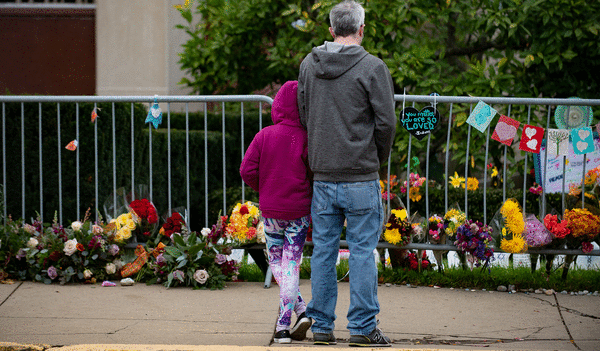
Attorneys for condemned Pittsburgh synagogue shooter Robert Bowers have formally filed an appeal to the Third Circuit Court seeking at least a resentencing for their client.
In a 500-page document, they argue, among a dozen other perceived issues, that the court improperly excluded some jurors, improperly included another juror, and improperly began shackling Bowers partway through the trial based on vague concerns from U.S. Marshals.
Filed earlier this month, the document raises 16 separate issues defense attorneys say necessitate at least a resentencing.
Bowers was found guilty in June 2023 of all 63 charges against him in connection with the Oct. 27, 2018, shooting at the Squirrel Hill synagogue. Jurors found him eligible to receive the death penalty a month later, and on Aug. 3, 2023 they unanimously sentenced him to death.
Eleven people were killed in the shooting: Joyce Fienberg, Richard Gottfried, Rose Mallinger, Jerry Rabinowitz, Cecil and David Rosenthal, Bernice and Sylvan Simon, Dan Stein, Melvin Wax, and Irving Younger. Two congregants and four police officers were wounded by gunfire.
U.S. District Judge Robert J. Colville, who presided over the Bowers trial, dismissed Bowers' initial appeal in early 2024. It's taken nearly two years for Bowers' attorneys, a team of federal public defenders, to finalize their appeal to the Third Circuit. Even then, records show, attorneys argued they'd not been given sufficient time to go through five years of pretrial motions and three months of trial testimony.
Some of the issues raised in the appeal relate to technical issues of law, and others were raised either in the moment during the trial or in Bowers' initial appeal. For example, attorneys argued during jury selections and again in their first appeal that prosecutors improperly excluded potential jurors who were Black, Hispanic and Jewish. More than that, they alleged, Bowers' trial attorneys weren't given sufficient time to make that argument in the moment.
Attorneys wrote in the Third Circuit appeal that prosecutors improperly struck, or excluded, jurors who said they were opposed to the death penalty but could follow the law — that is, that they could impose the death penalty if they believed prosecutors had sufficiently argued for it. They also took issue with a juror who said she'd previously reviewed death sentences and supervised executions in China.
"Though defense counsel questioned Juror 119 about her work in China and views on the death penalty — and challenged her for cause—the court misapprehended the issue as simply whether she could apply American rather than Chinese law and failed to consider whether she was biased," defense attorneys wrote.
Among the more notable new arguments brought up in the latest appeal: That Bowers was improperly shackled at the defense table during the guilt-determination phase of the trial. The decision, ultimately made by Judge Colville, was based on "security concerns" brought up by U.S. Marshals tasked with escorting Bowers into and out of the courtroom each day, according to the appeal.
Defense attorneys objected to the change — defendants are almost always without restraints during trials so as not to prejudice the jury — and to what they said was an opaque explanation by the judge. The sudden change happened in early July, and the appeal claims that Bowers' trial attorneys were repeatedly dismissed when they argued the numerous ways in which they said the shackles were harming their case. The appeal also alleges the attorneys weren't given a full explanation beyond "concerns" brought up by the marshals until months after the trial had ended.
Among the marshals' claims, according to the appeal: That Bowers had "made efforts in recent days to close the distance between himself and the armed deputy" escorting him into the courtroom. Other claims, per the appeal, included the marshals' perceptions that he was "restless in the courtroom in recent days, had been looking frequently at the exhibits, and had appeared close to standing up during some testimony."
The appeal alleges that Bowers' trial attorneys weren't given that information until weeks after marshals began shackling the defendant. Months after the trial ended, the appeal alleges, trial attorneys were informed that part of the reasoning behind the move was an email from a chief deputy marshal that said: "Butler County Prison Officers have reported that Bowers told them he knows who is armed and the feels confident he could disarm them."
The appeal indicates defense attorneys during the trial offered photos taken during breaks in testimony that showed how jurors could potentially see Bowers' shackled legs despite the distance from the jury box and despite the skirting on the defense table.
"This included not only during sidebars and while the jury was entering and exiting the courtroom, but at other times as well when one or more jurors had an unobstructed view of (Bowers') lower legs," his attorneys wrote in the appeal.
Federal prosecutors have 90 days to file a response to the motion.\
____
© 2025 the Pittsburgh Post-Gazette. Visit www.post-gazette.com. Distributed by Tribune Content Agency, LLC.




Comments