Being mayor was good for Francis Suarez. Was it good for Miami?
Published in News & Features
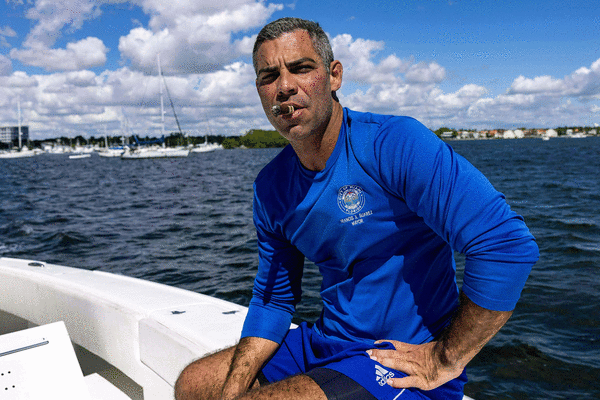
MIAMI -- Relaxed and chatty on a Friday morning in November, Francis Suarez sat behind the wheel of his wife’s spotless white Tesla as the self-driving vehicle piloted itself north on 37th Avenue. Still mayor for a few more weeks, he was out for a spin to tour the landmarks that symbolize his journey in Miami — a city whose story has been influenced by his own.
With his hands free and the car rolling, Suarez unlocked his iPhone and pulled up ChatGPT, which he refered to as “the oracle.”
“This is a tech mayor,” Suarez said of himself. “… He’s asking questions of an AI. He’s driving autonomously.”
The 48-year-old was enjoying the end of a 16-year run in elected office, first as a commissioner and then as mayor. The last half-decade has been a whirlwind for Suarez, starting with his viral 2020 tweet pitching the city as the next Silicon Valley. Anointed the “Bitcoin mayor,” he pushed to brand Miami as a tech hub and took credit for courting over a dozen tech companies and financial firms to the city.
Being mayor was good for Suarez. In eight years, his net worth exploded as he rubbed elbows with VIPs and world leaders while marketing the city and himself.
Was it good for Miami?
The city transformed during Suarez’s tenure, with millionaire money pouring in during COVID and an influx of ultra-wealthy residents flocking here to buy second homes. The mayor opened his arms to the millionaire class — a group that now includes Suarez.
As the city changed, so did Suarez. He catapulted the role of Miami mayor into the stratosphere, turning the position once held by his father into something celebrity-adjacent.
During his time in office, Suarez accumulated more than a dozen outside jobs, climbed out of debt and grew his net worth to $5.3 million. The part-time mayor traveled extensively to the Middle East on private business and forged connections with some of the most powerful people on the planet, including Donald Trump, Jeff Bezos and Saudi Crown Prince Mohammed bin Salman.
“If [Suarez] asks me to jump, the only answer is, ‘How high?’” billionaire Ken Griffin said onstage at last month’s America Business Forum conference, organized by Suarez. Trump and Bezos were featured speakers at the event sponsored by the Saudi sovereign wealth fund, a client of the law firm where Suarez is of counsel.
The leading candidates to replace Suarez in this year’s election agreed he’d masterfully marketed Miami — but criticized his frequent absences as leaving the city rudderless.
Suarez, though, says he never lost touch. The Francis Suarez who now has a $235,000 boat, a personal trainer and a vacation home in the Bahamas says he’s the same Francis Suarez who wore out a single pair of modest brown loafers as he knocked on thousands of doors when he first ran for office in 2009.
He kept those Cole Haan Nike Air loafers from his first campaign on a shelf as a reminder.
“I suffered in these shoes,” Suarez said from his second-story City Hall office overlooking Dinner Key Marina. He displayed them for all these years “because I always wanted to remember the suffering.”
On Thursday, he handed the keys over to Eileen Higgins, the city’s first woman mayor and the first Democrat elected in decades.
“There’s a part of me that wonders if people will still call me ‘mayor’ on the street,” Suarez said after Higgins’ swearing-in ceremony.
Suarez hasn’t said what he’s doing next but hinted at a potential upcoming announcement “on the private-sector side.”
He has faced a torrent of scrutiny in recent years. Critics say he used his title as mayor to build up his personal brand and benefit himself while abandoning the constituents who voted him into office.
Suarez says those critiques ignore and diminish the time and effort he’s invested into uplifting his hometown — having “put my heart and soul into the city for the past 16 years.” He’d rather talk about the World Cup Games coming to Miami Gardens next summer and the G20 summit in Doral — global events he says he helped bring to town.
That’s why, with an aide and a Miami Herald reporter in tow, Suarez punched in the address for his signature project, Miami Freedom Park, and the Tesla was on its way.
ChatGPT mayor
The under-construction soccer stadium — Suarez’s marquee project and the future home of MLS champion Inter Miami — was one of several stops on the “Tesla Tour,” as it was called in the calendar invite sent by the mayor’s office. The multi-stop pilgrimage across the Magic City doubled as an opportunity for Suarez to tout his accomplishments — and illustrated what life would look like for him once he was no longer mayor.
For the first time in more than a decade, Suarez is driving again. Unlike the Miamians forced to commute in rush hour traffic, the city’s elected officials are chauffeured around in black SUVs that, on occasion, flash their police lights to cut through traffic.
Leaving office means losing a driver and the 24-hour security detail that included an ever-present Miami police officer outside his Coconut Grove home.
But last month, a police escort tailed him as the Tesla approached the stadium, built on a former city-owned golf course.
“So we’re coming up on Miami Freedom Park. What can you tell us about the project and its virtues?” Suarez asked ChatGPT.
The mayor and his “oracle” went back and forth, agreeing on the benefits of the project Suarez has dubbed the “best sports deal in America.” Suarez pointed out that the stadium won’t rely on public subsidies.
“Yeah, that’s actually a really great angle to highlight. Miami Freedom Park is pretty unique in that sense,” the AI tool, sounding like a laid-back 30-something male, responded. Suarez seemed pleased.
“So here is, according to ChatGPT, one of my nice legacy projects,” Suarez said as the stadium site came into view.
A few minutes later, the Tesla beeped at Suarez, reminding him to keep his eyes on the road.
How would ChatGPT describe the mayor in three words, based on its interactions with him? Suarez appeared to brace at the question.
OpenAI’s large language model only had nice things to say: “Approachable,” “energetic” and “strategic.” Suarez looked relieved.
“He’s been analyzing me for a while, so he’s got a lot of data,” Suarez said. He’s embraced AI in his professional life, too, using ChatGPT to write a speech he gave to the Moroccan Consulate.
“People were laughing, crying, like, ‘That was amazing, what a speech, you know us so well,’” Suarez said.
The Tesla steered itself east, toward the Overtown Youth Center, a nonprofit that offers after-school programs and family services for which Suarez said he championed $1 million in funding.
Inside, the words “SPECIAL RECOGNITION TO MAYOR FRANCIS X. SUAREZ” were affixed in large silver letters to a wall in the lobby. He stopped the Tesla in the parking lot — leaving it running and with the door open — to dash inside to express his gratitude to the staff.
“Tears of joy,” he said on his walk back to the car.
Suarez is aware of what his critics say — that he put national and global attention over the needs of the city’s residents. Suarez says that narrative comes “from a place of ignorance.”
“They can’t imagine a world where someone’s versatile enough to do everything, right?” he said. “To be able to deal with the one-off complaints from a resident and to do something like the Overtown Youth Center, and then also to have this national-global profile. They just can’t — they just don’t understand that.”
The city improved under his leadership, Suarez believes, pointing to a decrease in the city’s homeless population, increased median wage growth and a lowered tax rate.
“I really do believe that we created a Miami for everyone,” he said. “We created a Miami where everyone has an opportunity to be successful.”
But Ned Murray, associate director of Florida International University’s Metropolitan Center and an expert in South Florida’s housing market, called modern-day Miami a “tale of two cities,” with the majority of the city’s workforce being the “have-nots.”
“Other than the ultra, ultra wealthy that have come into the city since COVID, there’s just no evidence — in fact, it’s contrary evidence — that the average resident, typical resident, of Miami has benefited in any way in terms of wealth building and prosperity,” Murray said.
Suarez said there are growing pains in any evolving city.
“You can’t build a wall and prevent a certain kind of person from coming into your city,” Suarez said. “You don’t have the power to do that, right? You’re not going to create a city that’s less desirable to slow down demand and to keep prices down.”
Democratic pollster Fernand Amandi, who voted for Suarez in 2017, said Suarez’s “mayoralty was a master class in slick branding but defined by absentee, hollow-at-its-core governance.”
“Ultimately, Suarez’s tenure will be remembered as a social media-driven mayoral performance that left behind disturbing ethical lapses, made him a multimillionaire, and squandered potential more than tangible progress and accomplishment,” Amandi said.
Suarez’s second term as mayor was especially controversial. A lawsuit in 2023 revealed that an embattled developer seeking City Hall approvals was paying Suarez $10,000 a month as a consultant. Suarez said his job had nothing to do with City Hall, but the revelation led to accusations that he used his position to enrich himself and blurred the lines between his public office and private business dealings.
The SEC and FBI launched investigations into the developer, Rishi Kapoor. Suarez was deposed in the SEC’s case last year, but says he has never been contacted by the FBI, whose investigation is ongoing. Suarez was not a target of those investigations and has long denied any wrongdoing.
Asked if there was anything he’d do differently in his time in office, Suarez said earlier this month that there are “one or two things I would not have done” that “just caused more heartache and more heartburn than necessary.”
Without specifying, he added: “That’s how you learn.”
‘Vota por papi’
Suarez, dressed in a pinstripe suit, sat on a dingy couch backstage at Kaseya Center last month as he practiced the questions he was going to ask Amazon’s founder.
It was Day 2 of the America Business Forum, and Suarez was about to interview Bezos onstage — the grand finale of the two-day event Suarez described as his “gift to the city.” Tickets ranged from $100 for general admission to $10,000 for an all-access pass.
Suarez said he wasn’t nervous. A self-described perfectionist, he said it’s important to have the mentality of “I belong on the stage.”
“It’s all reps-driven,” Suarez said. “After 16 years of public service, you have so many reps.”
Suarez’s “reps” stretch back decades — long before he became a city commissioner in 2009 at age 32. At just 2 years old, he was enlisted to help his father, Xavier Suarez, campaign for office in the city of Miami.
“Vota por papi,” Francis Suarez, then a toddler, said in a 1979 radio commercial for his father’s failed City Commission run.
Six years later, Xavier Suarez made history when he was elected as the city’s first Cuban-born mayor.
That December, an 8-year-old Francis was quoted in the Miami Herald. He was at a festival, sitting next to his dad on the hood of a car, as he “frequently threw his arm around his father.”
“I like it because he is happy,” Francis said. “And I don’t like it because he doesn’t spend much time with me.”
When a reporter read that excerpt to him in a recent interview, his eyes filled with tears.
He said despite his busy schedule, his dad made an effort to spend time with him growing up. He recalled memories of the two playing basketball in city parks and going to 7-Eleven afterward. Xavier would get a Big Gulp, and Francis would get a Coca-Cola Slurpee. Francis, now a father himself, credits wife Gloria with making things as normal as possible for their kids, Andrew, 11, and Gloriana, 7.
By his own estimate, Francis Suarez has spent half of his life as either an elected official or the son of one. Xavier was mayor from 1985 to 1993 and again from 1997 to 1998.
Rita Suarez, Francis’ mother, said she was surprised and not particularly excited when her son decided to become a politician.
“Because I think that the fact that his dad was absent from his life in — not all the time, because my husband really made an effort to, you know, be home at a certain time,” Rita said. “But … it’s always difficult to balance, you know, both things.”
Having been Miami’s first lady during the ‘80s and ‘90s, Rita called the role of mayor a “thankless job.”
“This is not a pretty world,” she said.
Rita described Francis as a rambunctious, smart kid who was doted on by his three little sisters. Growing up, he would count down from five to see which of them could get him a glass of water the fastest.
“And then he would say, ‘You get five points!’” Rita said. “And I would say, ‘Five points towards what?’”
“Not even a real bribe. Just a rhetorical bribe,” Xavier, reminded of the story, said during a recent interview.
Xavier described Francis growing up as “precocious,” “feisty” and athletically gifted. He said that when Francis was about 11, he would play ping-pong with his left hand because doing it right-handed was “too easy.”
Growing up as the mayor’s son was “a weird thing,” Francis said. Sometimes, when someone would make a threat against Xavier, a police officer would sit in Francis’ classroom.
Things got especially difficult after the 1997 election, Francis recalled. His dad had initially won the mayoral race against opponent Joe Carollo, but the election was later overturned because of ballot fraud. Xavier was not implicated.
The ordeal, which resulted in Xavier being removed from office and replaced by Carollo, caused significant hardship for the family. Xavier had quit his job as an attorney to commit to being mayor, so when the election was overturned, he lost his only source of income. The family had to sell their house, and Francis, then a sophomore at Florida International University, spent months sleeping on a twin mattress on the floor of his grandmother’s apartment.
“I probably try to erase that part of my life from my brain — the trauma associated with that,” he said.
The mayor’s chief of staff, Carlos Ignacio Suarez — Francis’ distant cousin — thinks that experience contributed to his boss’ seemingly relentless pursuit of success.
“I think he doesn’t want to be, ever, in that position for his family,” Carlos said, describing Francis’ work ethic as “second to none.”
“Francis never stops being mayor,” he added.
Carlos has spent years by Francis’ side, including as a top campaign staffer during his short-lived run for president in 2023. He said his boss has been viewed “as this persona of the rich and famous. But that’s not Francis.”
He said he has seen Francis ask his police escort to pull over “so he can go give a hug to someone on the street, give a kiss to a homeless person, ask them what they need.”
Xavier said his son doesn’t seek out the “rich and famous.”
“It’s not him. It’s them,” Xavier said. “They want to hang around with him.”
‘Second-floor mentality’
It’s just after 8 a.m. on a Tuesday, and Suarez and his wife are in a “battle of the volume” as electronic music pumps in their backyard. Every time Gloria turns the music down, he turns it back up.
They begin what’s become a weekday ritual: an hourlong 8 a.m. workout led by a tattooed, motorcycle-driving personal trainer named Ossie.
Suarez, a self-described “health freak” who tries to avoid sugar and gets mineral IV infusions to promote mental clarity and anti-aging, says there’s a correlation between the success he’s experienced and getting a personal trainer about five years ago.
“His workout hour is untouchable,” says his chief of staff, “and him and I used to argue about that all the time.”
Suarez installed a towering outdoor gym in his own backyard, complete with a cold plunge. This is where Suarez filmed a viral social media post with side-by-side videos of himself and then-New York City mayoral candidate Zohran Mamdani on the bench press. Suarez lifted 225 pounds, Mamdani 135.
“Socialism VS Capitalism,” Suarez captioned the Instagram post. Mamdani never responded, Suarez said.
After the morning workout, Suarez would usually head to City Hall, about a 15-minute drive from his Coconut Grove home.
As mayor, he occupied a palatial second-story office with panoramic views over Biscayne Bay and an overhead view of the City Commission chambers.
In his first term, Suarez tried to lead commission meetings and make the job of Miami mayor more involved, championing a 2018 “strong mayor” ballot referendum that voters overwhelmingly rejected. Since then, he’s taken a new approach.
“We adopted what we call the second-floor mentality,” Suarez said, defining that philosophy as: “Focus on the things you can control, be the visionary, right? And operate at the macro level.”
He now sees the silver lining, or “unintended consequence,” in the referendum’s failure.
“Interestingly, it inured to my private benefit tremendously that I did not become a strong mayor. … I was able to do much better financially,” he said.
Suarez has received criticism for being largely absent from City Commission meetings. But Suarez said keeping his hands off the wheel has been a helpful exercise in restraint when dealing with a rowdy commission full of strong personalities and egos.
“I’m an alpha,” he said. “I like to, you know, alphas like to control. I want to control. I want to control the outcome. I want to control the agenda. And what I learned — which is counterintuitive to my personality — is, if I want to be effective with these guys, I got to back off. I got to take my foot off the gas.”
As the Tesla Tour neared its end, Suarez navigated to Miami Worldcenter downtown. An Uber was parked in the middle of the street, blocking traffic.
“My temptation is to take over and try to go around it, but it probably isn’t a good idea,” Suarez said.
He changed his mind, switching the car into human-led driving mode. “I’m taking over,” he said.
Suarez kept driving, and almost accelerated through a red light. Maybe, he acknowledged, he should have left the Tesla in control. “Therein lies the danger of Francis driving,” he said.
©2025 Miami Herald. Visit at miamiherald.com. Distributed by Tribune Content Agency, LLC.





Comments