Illinois mom covers 250-mile distance to reunite formerly detained immigrants with their Chicago families: 'They deserve to know somebody cares'
Published in News & Features
It’s pitch-black and frigid in the parking lot of an Italian restaurant in Michigan City, Indiana, by the time a small group of volunteers and immigrants gather in a circle, arms resting on each other’s shoulders and heads bent in prayer.
A pastor tells three Chicago-area men, who just hours ago had been released from an ICE detention center in Michigan, that God loves them. That any mistreatment they may have experienced didn’t escape his attention. That God will walk with them on the rest of their journey.
It’s a message that Rebecca De La Luz, one of the intrepid volunteers who wears a blue T-shirt that says “madre all day every day,” feels deeply as she nodded along that early December day. She’ll soon drive the men hours back to the city and suburbs for emotional reunions with their families, the next conductor in what the group wryly referred to as the “above-ground railroad.”
“Everything that’s happening, I want to be proactive and do something because I know in my heart that it’s not right, and these people aren’t criminals and they’re not bad people,” said the 36-year-old Machesney Park resident and mom of three. “They deserve to know somebody cares about them.”
De La Luz’s actions, along with the others she works with across Illinois and Michigan, in many ways represent the next step in community resistance after President Donald Trump’s aggressive immigration enforcement campaign swept the Chicago region this fall.
The Department of Homeland Security has said it arrested more than 4,300 during the two-month Operation Midway Blitz but has not offered more detailed figures on the backgrounds of detainess. More detailed data of many of the arrests, both obtained by the Tribune and as part of a federal lawsuit, indicate that most detainees do not have significant criminal records.
Thousands of people rallied against the raids, participating in protests, small and large, and many more handed out whistles so bystanders could alert immigrants of the presence of federal immigration agents.
These days, De La Luz fields around 50 calls a day from concerned family members and people detained at the North Lake Processing Center in Baldwin, Michigan, a small village about a four-hour drive from Chicago. She writes letters and puts together backpacks filled with clothes and toiletries. She even makes in-person visits at the U.S. Immigration and Customs Enforcement facility.
De La Luz wants to let immigrants know they haven’t been forgotten.
“I just kept thinking ‘what happens after they get arrested?,’” she said.
‘So happy to be home’
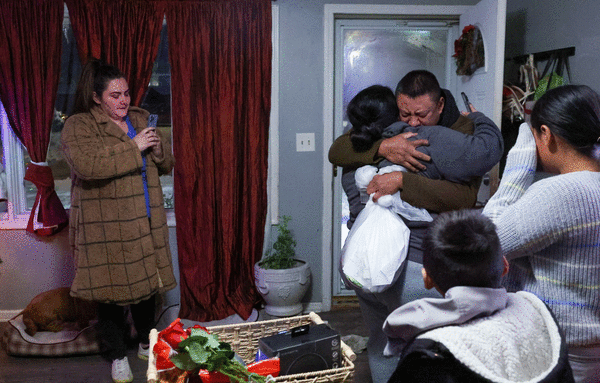
De La Luz’s last stop of the night, just after midnight Dec. 5, was at Manuel Cruz’s home in Elgin. Before the 39-year-old can even walk through the front door, he begins tearfully hugging his wife, two daughters, son and employers.
They had been waiting all day for him to arrive after he was released on bond. Many of those released from detention that De La Luz helps are released on bond or habeas corpus, waiting for hearings to determine their future.
Cruz’s daughter carried a poster that read “Bienvenido a casa” or “Welcome Home” decorated with a Christmas tree she drew.
“I’m so excited, so happy to be home,” Cruz said. “But I’m sad for the people I left over there … and I’m scared to get back to the same situation.” His next hearing is scheduled for January.
Cruz was arrested last month while at his landscaping job. He said he’s lived in the U.S. since he was a teenager, fleeing cartel violence in Mexico. He was briefly detained at an ICE processing center in west suburban Broadview before being moved to Michigan. The hardest part, he said, was that his kids struggled at school while he was away.
His wife found De La Luz on Facebook where De La Luz posts videos of reunions and other information to about 7,000 followers. Cruz carried a list of names and phone numbers in his pocket of people detained he hoped to one day help, following in De La Luz’s footsteps.
“All she’s doing, it’s amazing, like God put her (on the earth) to help people,” Cruz said. “I don’t have no words to say how grateful I am. I told her … even though I can’t do much I will do anything I can to help other people.”
When she left the home, De La Luz also teared up.
“It’s so sad but so happy, I don’t even know what the word is,” she said. “It means everything to me.”
A reunion 12 hours in the making
De La Luz’s day started long before the tearful Cruz reunion. In fact, it was more than 12 hours in the making and began with lunch at El Faro restaurant in Elgin. Between bites of chips and salsa, she answered an onslaught of calls, texts and Facebook messages, writing notes on a slip of paper and sorting out logistics.
She didn’t know yet she’d be driving released immigrants back to their homes deep into the night. It’s typical for her not to know until the last minute, she said.
But as she waits for those phone calls, she has other jobs to check off a list, including collecting clothing and other donations across Chicagoland.
On that particular day, she made stops at parking lots, homes and apartment buildings in Elgin, St. Charles and Chicago to collect supplies to go in backpacks. In the past two months, she said she’s put together dozens to give to detainees. Sometimes families give her passports or other documents for her to deliver as well.
Having a change of clothes is a “little piece of dignity,” De La Luz said.
Pinar Garcia, 48, handed off shoes and clothes she assembled from her closet. She also found De La Luz on Facebook, and she hopes the clothes can give those who are detained hope, as well as keep them warm — both inside and out.
“We have such a community here in Elgin,” she said. “We support one another.”
De La Luz said she’s long believed in advocating for immigrants, even though she isn’t one. Growing up, she remembers disagreeing with certain views of family members, solidifying for her that it isn’t right to judge someone because of the color of their skin. Her husband is also an immigrant, she added.
But Operation Midway Blitz affected her family personally when a relative was arrested and detained at North Lake. She was heartbroken when her young kids, who are Hispanic, asked if ICE agents would come looking for them.
While the relative was at the facility, she visited others and learned more about the needs of detained immigrants. She began writing encouraging letters in October, and put money on commissary accounts. People then started to contact her directly, and she offered to bring them belongings.
Claudia Figueroa, 37, of West Ridge, started writing letters to detainees after meeting De La Luz through Facebook with her ministry group Treasures Out of Darkness. They craft messages telling people they aren’t alone and that God has a purpose for their life, she said.
Figueroa said she quickly started receiving calls from people she wrote to.
“It’s so heartbreaking how they’ve never been in jail before because they’re not criminals,” she said. “The only bad thing they did was to have that dream and that desire to provide for their family.”
North Lake has 1,800 beds in its facility. Democratic Rep. Rashida Tlaib of Michigan called it the largest immigration detention center in the Midwest when she conducted an oversight visit earlier this month.
Many of the people detained in the center are from Illinois. In fact, more than 400 people originally arrested in the Chicago area were sent to North Lake during the first five weeks of Operation Midway Blitz, according to a Tribune analysis of ICE data obtained and shared by the research group Deportation Data Project. (Illinois doesn’t have ICE detention centers under state law.)
In November, De La Luz heard about a woman who needed help picking up a family member at the facility. The only reason the man couldn’t leave is because he didn’t have a ride, so De La Luz volunteered for the job.
“That same week I had like five people get out, and I went back and forth to get them,” she said, adding that the total is now up to about a dozen people.
Connections in Michigan
After De La Luz finished picking up donations in Chicago on Dec. 4, she began the more than hourlong trek to Indiana. She arrived early and made a detour to buy flowers, which she gave to the men so they had a gift for their wives.
De La Luz split the 250-mile distance from the North Lake facility with Dale Dalman, a retired pastor. He picked up the men in Michigan and drove them to Indiana, where De La Luz then covered the rest of the distance to Chicago.
That night, she dropped one man off in a northwest suburb and another in Humboldt Park, where around a dozen family members ran outside in the cold to greet him.
Dalman, 68, said he connected with De La Luz — who he called an “angel” — on social media after his own trips to the facility to visit a friend and former congregant who was detained.
Families are sometimes scared to pick up their loved ones because of the presence of agents. Uber and public transportation also aren’t readily available, so Dalman said providing rides felt like a natural way to help.
“As a pastor and a follower of Jesus, I believe if Jesus was here, that’s exactly what he would be doing. He’d be giving people rides to get home,” Dalman said. “I want to be the hands and feet of Jesus.”
Dalman said he also regularly visits people detained at the facility, often using referrals from De La Luz. He’s able to bring in a Bible on the pastoral visits, and his go-to reading is Psalm 23. He hopes it brings some comfort because many immigrants are losing hope.
“I can’t change their situation. I can’t make promises of what’s going to happen,” he said. “The only thing I can do is read them scripture.”
‘You’re not alone’
Outside of this volunteer work, De La Luz is a mom to two boys and a daughter and works part time at a social service agency. She also helms the Parent Teacher Organization for her kids’ schools, and coaches basketball and cheerleading. She loves the song “Stand Up” by Cynthia Erivo.
De La Luz’s aunt, Tina Ward, 65, said she’s someone who always felt like she had to stand up for the underdog. She’s a person with “heart,” Ward said.
“If I had a daughter, I would want her to be just like her,” Ward said.
De La Luz’s 10-year-old daughter, Juliana, said she thinks what her mom is doing is good because she’s “helping other families.”
With the time commitment, De La Luz said the rest of her family has had to take on more responsibility, but that she always arranges meals and rides for sports ahead of time. It’s worth it, she said, to feel like she’s a “small part of a bigger plan.”
“No estás solo en North Lake,” said De La Luz, whose last name means “of the light” in English. “You’re not alone at North Lake.”
____
Chicago Tribune’s Stacey Wescott and Joe Mahr contributed.
©2025 Chicago Tribune. Visit at chicagotribune.com. Distributed by Tribune Content Agency, LLC.






Comments