'Not a red-blue issue': Md. data center impact study bill, vetoed by Moore, sees new bipartisan push
Published in News & Features
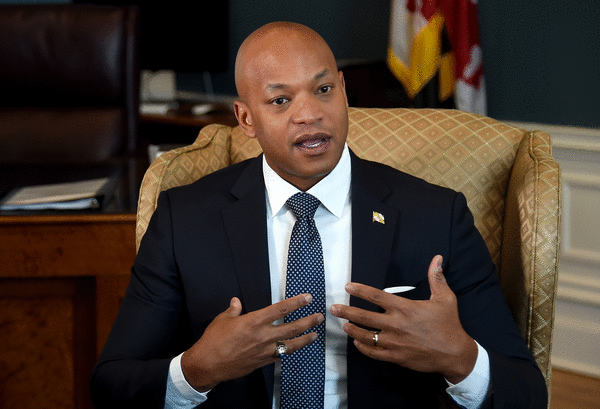
At the end of Maryland’s legislative session earlier this year, Gov. Wes Moore vetoed some 29 bills, looking to shave off extra costs as the state faced budget constraints.
Just six months later, a growing bipartisan coalition of both lawmakers and advocates across the aisle is worried that one of these vetoes — the Data Center Impact Analysis and Report bill, or Senate Bill 116 — was a critical mistake.
“Virginia did (this) a bit too late. They rolled out a large number of data centers and then asked questions later,” said state Sen. Karen Lewis Young, a Democrat from Frederick who sponsored the bill. “I have to wonder, if we were having the conversations back in March that we’re now having today throughout the state, maybe that bill would have had a different outcome.”
With the General Assembly poised to override Moore’s veto of SB 116 during its special session, which starts Tuesday, advocates say the governor’s hesitancy to invest in studying data centers could cost Maryland valuable time in its effort to regulate them.
The bill would have commissioned a $502,000 study on the impacts of data centers on Maryland’s economy, environment and energy grid, aiming to guide future zoning laws about these centers. It had broad support when it was passed in April, but Moore said he wanted to focus on vetoing bills that called for labor-intensive studies — a rationale that some lawmakers said they understood, even if they didn’t agree.
In the short time since then, though, interest in data centers has “exponentially grown” across Maryland, Young said. From Frederick to Prince George’s County to Baltimore County, tech companies are taking a greater interest in Maryland as a potential data center hub. And even outside areas that are seeing data centers coming in, rising energy costs and the Maryland Piedmont Reliability Project have brought this industry into the statewide conversation.
“We’re seeing how many people cannot afford to pay their electrical bills,” said Dave Arndt, co-chair of the Maryland Legislative Coalition Climate Justice Wing. “And I’m really seeing that, you know, this is not a red-blue issue. This is affordability to everybody.”
Bipartisan backing
The General Assembly has identified SB 116 as one of about 10 bills vetoed by Moore that it wants to try to override during the special session this week. Both Young and state Sen. Justin Ready, a Republican representing Carroll and Frederick counties who co-sponsored the bill, said representatives in their parties are willing to vote for this override.
That unity is a rare thing in Maryland, where Democrats and Republicans typically split on issues related to energy. But conservatives like Ready, who are prioritizing energy and affordability in their 2026 legislative slate, are finding common ground with environmentalists and renewable energy advocates.
“I don’t think we want to have a bill that says, don’t ever have a data center in Maryland,” Ready said. “But we need to have really common-sense protections for consumers, for people who live near one and, you know, environmental protection.”
As attention on data centers grows, Moore’s decision to veto the bill has also sparked questions among some about whether Democrats are unified on these energy issues — and whether that unity will start to solidify now that data centers are under greater scrutiny. Ready called the veto a decision that “went against the normal messaging of [Moore’s] party,” while Young said she expected that growing “awareness and caution” in the months since the veto might have changed the governor’s mind.
Though many said they understood Moore’s reasoning for vetoing bills that commissioned studies, Arndt pointed out that the $500,000 study would have been “nothing” compared with Maryland’s $61 billion budget for this past fiscal year.
Steve Black, president of Frederick County environmental advocacy group Sugarloaf Alliance, said Moore’s veto of the bill signaled, to him, a split between “the corporate Democrats and the old-school, environment-conscious Democrats.”
“I think it was, until very recently, a central tenet of most Democrat policy folks, that greenhouse gas emissions were bad, climate change was a very real threat and that we needed to work very hard on policies to reduce both emissions and climate change,” Black said. “I mean, that was like, a standard thing, and now we have Democrats who are willing to turn a blind eye to the emissions and climate change implications of the data center industry.”
Late to the game?
Watching from across the Potomac River as Virginia rapidly upscaled its data center industry, Young said she started sounding the alarm on the need to investigate and regulate data centers nearly 2 1/2 years ago.
“People were looking at me like, why would you want to prevent data centers?” Young said. “And I kept explaining, I don’t want to prevent them. I want to do them right.”
Now, as major projects like Frederick’s Quantum Loophole come closer to a final decision, Black and Young both said they’re worried the state might be behind on researching this industry. The initial version of SB 116, if it had been signed into law in May, would have had a target completion date for the report of September 2026. If the bill is overridden next week, that date will likely be pushed back.
Meanwhile, the costs of data centers, both in terms of prospective revenue for Maryland and future energy demands, are still not well understood by many policymakers. PJM Interconnection, which manages the electric grid in Maryland, Virginia and 11 other states, has projected that it will see an increase in power demand of about 32 gigawatts by 2030 — 30 gigawatts of which will come from data centers.
But at this point, Black said, a study on the industry is “better late than never.”
“You need to find the truth that exists in between the developers’ sales pitch, and a community member that maybe really doesn’t understand how the industry works. They just don’t want a huge industrial project,” he said. “Somewhere in between the two is reality, and if you’re going to craft appropriate legislation, you need a data set to use.”
_____
©2025 Baltimore Sun. Visit baltimoresun.com. Distributed by Tribune Content Agency, LLC.





Comments