South Bay households to receive more air purifiers as sewage crisis persists
Published in News & Features
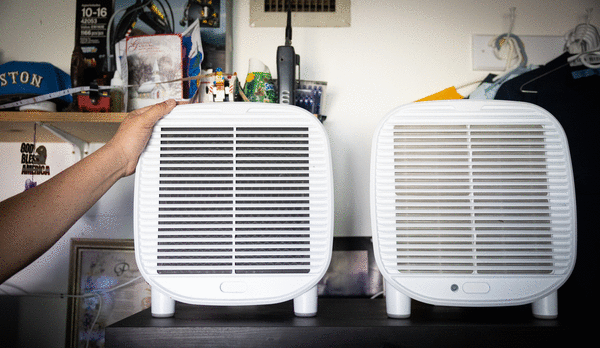
SAN DIEGO — The San Diego County Air Pollution Control District’s (APCD) governing board voted unanimously Thursday to expand its air purifier distribution program for South County residents affected by cross-border pollution from the Tijuana River sewage crisis.
The board approved up to an additional $1 million for the Air Improvement Relief Effort Program, or AIRE, with plans to seek funding sources to increase the number of air purifiers per household from one to three units.
At an APCD distribution event Monday in Imperial Beach, resident Camille Bernard picked up a second purifier for herself and her two small children. She said having more than one unit for her home is essential.
“We do have an air purifier in the bedroom we sleep in, but we have three levels to the place that we live in,” Bernard said as volunteers loaded a purifier and two filters into the trunk of her car. “Having the chance to have another one in our space just seemed like something that I wanted to utilize.”
County Supervisor Paloma Aguirre, a member of the APCD governing board, spearheaded the effort.
“I know that while we celebrate our accomplishments so far, it is equally important to be clear that our work isn’t finished,” Aguirre said during the meeting. “To effectively safeguard public health, far more air purifiers must be delivered to meet the scale of need in the communities impacted.”
A stopgap solution while broader infrastructure changes are being made in the long-term, the AIRE program was launched earlier this year with $2.7 million in funding for 10,000 purifier units to be distributed among residents of Imperial Beach, Nestor and San Ysidro.
Neighborhoods bordering the Tijuana River Valley face ongoing environmental challenges from cross-border sewage flows that create air and water quality issues. The sewage exposes residents to unpleasant odors and harmful airborne substances like hydrogen sulfide, which can cause breathing difficulties, headaches, nausea and irritation.
The air purifiers use carbon filters to remove hydrogen sulfide and other gases, plus potassium permanganate filters to clear pathogens. Each unit covers 400 to 500 square feet and lasts about 15 years with annual filter replacement.
San Diego Mayor Todd Gloria, a member of the governing board, said during the meeting that while air purifiers only treat symptoms and comprehensive solutions may take years, “that is not an acceptable answer to the residents of South San Diego.” He said officials must address the crisis “with the seriousness that it deserves.”
“I would argue that our partners at the federal level, on both the U.S. and Mexican sides, have a primary responsibility for addressing this issue,” said Gloria. “But we have not allowed that to be an excuse for us to not engage — quite the opposite.”
The expansion plan allocates $1 million to provide purifiers to additional South Bay households using funds from Assembly Bill 617. A state law, AB 617 requires air districts to implement air monitoring systems and emissions reduction programs in communities with high pollution burdens, with air districts receiving grants and state allocations to fund these programs.
The district will also seek broader funding sources for roughly $10 million to expand the program long-term, aiming to provide three units per household for approximately 30,000 units total. Potential funding named by the board included federal, state and philanthropic sources.
Marcus Bush, chair of the APCD board, raised concerns during the meeting about allocating more resources to the AIRE program, noting that other district programs have already been affected by AIRE’s extensive resource demands.
During the meeting, APCD staff said allocating additional resources to AIRE would cause further delays to the Portside Air Quality and Improvement Relief Program. The two-year PAIR program provides air purifiers to homes in Barrio Logan, Logan Heights, Sherman Heights and National City — neighborhoods adjacent to heavy industrial, freight and freeway activities.
“That’s a concern for me,” said Bush, who also serves as National City vice mayor. “I’m not opposed to (the AIRE expansion plan), but that is a concern.”
The decision follows APCD survey results showing the air purifiers are helping South Bay residents breathe easier, with users reporting fewer asthma symptoms and improved respiratory comfort. Other benefits reported included better sleep, less coughing and throat irritation, and fewer headaches.
“The survey results clearly confirm that the distribution of air purifiers provides real and essential relief for families who’ve been suffering far too long,” Aguirre said in an email prior to the meeting. “They’re not the solution but they are a necessary lifeline for South Bay residents who continue to suffer from the impacts of the Tijuana River sewage crisis.”
Of the 1,207 residents who responded to the survey between Sept. 9 and Oct. 3, nearly 80% reported the devices reduced odors in their homes, with a third saying odors were significantly reduced. About 35% of users reported fewer allergy or asthma symptoms, while 33% experienced improved breathing comfort.
“I am one of the many people impacted by the air pollution who has benefited from the initial purifiers,” said San Ysidro resident Christina Green, adding, “being able to wake up without a dry or sore throat, without my eyes being dry, or without massive headaches when I’m sleeping in my own room, has been phenomenal.”
©2025 The San Diego Union-Tribune. Visit sandiegouniontribune.com. Distributed by Tribune Content Agency, LLC.






Comments