The 'long process' of getting the nuclear waste out of San Onofre shows signs of life
Published in Business News
Progress on the multi-decades problem of what to do with nuclear waste from commercial power plants in the U.S. occurs at a glacial pace, but Rep. Mike Levin, D-California, said he’s encouraged by a couple of recent developments that may finally lead to the canisters at the San Onofre Nuclear Generating Station moving to another location.
“Look, I’m very clear-eyed that it’s a long process, it’s not going to happen overnight,” Levin said in a phone interview last week with the Union-Tribune. But the congressman, who has been in office since 2019, said news of Nuclear Lifecycle Innovation Campuses and further testing of a specially designed railcar to carry loads of waste represents “the most progress we’ve had” since funding for the Yucca Mountain nuclear waste site in Nevada was scrapped.
Earlier this summer, five states — Utah, Tennessee, Oklahoma, Louisiana and Idaho — signed memoranda of understanding with the U.S. Department of Energy to consider hosting the nuclear campuses aimed at strengthening and modernizing what’s called the nation’s “full nuclear fuel lifecycle.”
Among the list of things the project hopes to tackle is finding one or more potential disposal sites for the 95,000 metric tons of radioactive waste that has accumulated over the years at commercial nuclear power plants in 35 states.
That total includes 3.55 million pounds (or about 1,610 metric tons) of spent nuclear fuel rods and other debris that is stored in canisters at the now-shuttered San Onofre power plant, also known as SONGS for short.
On another front, the Atlas Railcar System that looks to ship heavy casks filled with spent nuclear fuel is close to completing testing and certification.
Levin said the specially-designed 12-axle railcar expects to undergo a final cross-country test run around April. If all goes well, the railcar could get the green light to ship a canister of spent nuclear fuel from the North Anna Power Station in Virginia to the Idaho National Laboratory in the third or fourth quarter of next year.
“Two of the key roadblocks have always been that, No. 1, you can’t move the fuel if no one wants to take it,” Levin said. “And No. 2, you can’t move the fuel if there’s not a safe method of transporting it.”
But Levin believes reaching out to communities and asking whether they are willing to host nuclear sites and their inherent responsibilities — as seen in the five states expressing interest in the Nuclear Lifecycle Innovation Campuses — can help solve the first issue.
That lesson was hard-learned by the federal government, after Congress in 1987 approved the Yucca Mountain nuclear waste site, despite opposition from Nevada lawmakers. Some $15 billion in taxpayer money was poured into the project before the Obama administration’s 2011 budget withdrew funding for Yucca.
“I’ve always believed that the government’s top-down approach, jamming Nevada, was the wrong thing to do,” Levin said, pointing to progress made in places such as Finland, where a consent-based approach led to the construction of the Onkalo spent nuclear fuel repository that is scheduled to open at the end of this year.
And the Atlas Railcar System, Levin believes, can help answer the second question — how to transport commercial waste from one place to another.
“We’ve funded around $33 million and counting for that initiative over the past number of years,” he said.
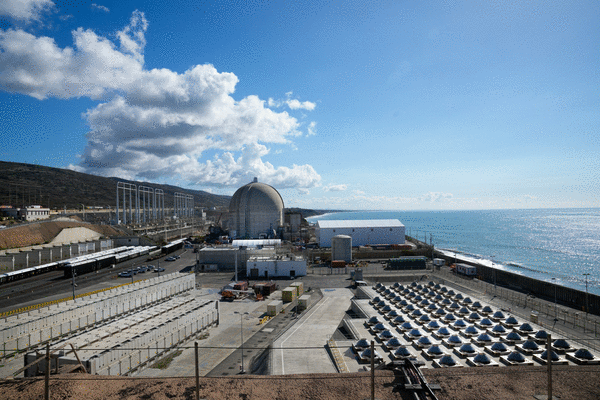
The canisters at SONGS are located at a pair of storage facilities at the north end of the plant, about 100 feet from the Pacific and behind a sea wall 28 feet high, as measured at average low tide at San Onofre Beach.
One storage site contains 73 stainless steel canisters containing radioactive spent fuel that have been lowered into vertical cavities. The other holds 50 canisters that are stacked horizontally.
An additional 13 canisters of material from the plant’s ongoing dismantlement efforts, which are classified as greater than Class C waste, sit in the horizontal storage facility.
“Some will just see the fuel sitting on the beach, and they would be asking what the progress really is,” Levin said. “I’m not going to declare victory, and I haven’t and I won’t, until we move every canister out of there.”
Last week, Levin released a 19-page report on SONGS.
Among the pieces of Capitol Hill legislation Levin wants to pass is the Spent Fuel Prioritization Act. Currently, it’s presumed that once commercial waste can be shipped, the oldest spent fuel will go to the front of the line.
Levin wants to give priority to waste at decommissioned nuclear sites near large populations, with hazards that include a history of seismic activity. SONGS would certainly meet those qualifications.
When asked when the first canister might be moved from San Onofre, Levin said, “There are a lot of steps that have to occur between now and then, but it’s my hope and expectation that if all goes well, (it would be) toward the middle to the end of next decade, the back-half of the 2030s.”
By contrast, under the “oldest fuel first” system, Levin said the waste at SONGS falls roughly in the middle of the pack. “So the prioritization (legislation) is key … I’ve been told by (the Department of Energy), between waiting 20 or 30 years,” he said. “So you’re talking about the 2030s versus the 2050s. It’s obviously a big deal.”
Operated by Southern California Edison, SONGS is in the midst of an eight-year dismantlement project. Thus far, 54 of 66 structures have been removed, and crews have shipped more than 750 million pounds of waste off-site.
Once the demolition work is finished, all that is expected to remain will be the two dry storage facilities; a security building with personnel to look over the waste; the seawall; a walkway connecting two beaches north and south of the plant, and a switchyard with power lines.
The switchyard’s substation without transformers stays put because it houses electricity infrastructure that provides a key interconnection for the region’s power grid.
©2026 The San Diego Union-Tribune. Visit sandiegouniontribune.com. Distributed by Tribune Content Agency, LLC.









Comments