Why General Mills is reinventing the stale cereal bag
Published in Business News
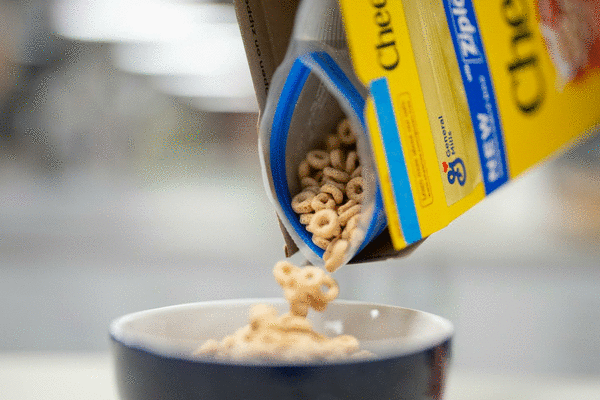
Tired of stale cereal? General Mills is trying to zip up the issue.
The Golden Valley, Minnesota-based company launched boxes of Cheerios and Honey Nut Cheerios on Walmart.com equipped with bags featuring Ziploc seals.
As of Oct. 30, the 14.4-ounce resealable Honey Nut product costs the same as an 18.8-ounce box with a traditional bag. The new bags, intended to preserve freshness while feeling like what consumers expect, are the result of years of work and consumer requests.
“Helping make sure that their product stays fresher longer not only makes their experience more enjoyable, but it also reduces food waste and it helps them want to buy our cereal again,” said Alyssa Buckalew, General Mills’ vice president for innovation, technology and quality.
The new cereal bags are one way Minnesota food companies are repackaging grocery staples from bacon to butter in an effort to increase convenience for consumers.
Consumers are making careful choices at the grocery store amid inflation, and executives at companies such as General Mills and Hormel Foods have said new and improved products can win over consumers in search of better flavors and more convenience.
At General Mills, this cereal bag redesign had roots in a packaging innovation lab at the James Ford Bell Technical Center in Golden Valley, a room with limited-edition cereal boxes on its walls and long workstations that would be fit for a high school chemistry class.
On a recent Thursday, Buckalew showed off how the blue Ziploc seal stretches across only half of the bag, allowing its top to open like a spout.
Alyssa Harben, who studies consumer behavior and sustainability at Michigan State University’s School of Packaging, said she has seen social media commentary saying consumers want cereal bags to be re-closable, and the Ziploc solution seems intuitive.
Packaging strategy is significant, she said, because consumers often don’t separate products from their packaging in their heads.
“You’re choosing it oftentimes from the packaging, even if you’re not thinking about it that way,” she said about consumers’ purchases.
Hormel bacon manufacturing manager Dan Vierkandt was thinking a lot about packaging when he was grocery shopping at a Hy-Vee in early 2019.
“Since I’m in the food industry, I love looking at what new items are out there,” he said.
He was impressed by foods sitting in packages consumers could cook them in, and he wondered if he could apply that style of packaging to bacon.
That summer, Vierkandt made a plan for how to safely cook, mass-produce and finance a bacon product that could bake in its original package.
Baking bacon can lead to better results than frying it, but it can still leave a mess.
Vierkandt pitched his idea for bacon that bakes in its disposable package to the Austin-based company’s top executives at a “Shark Tank”-style competition. They liked it.
Plastic became a key challenge in the design. Vierkandt felt consumers would not want to put plastic in their ovens, so his team instead landed on a paperboard that’s stable in the high heat to cook the bacon.
He said the tray bakes the bacon better than a metal pan, which can overcook the meat.
“Anybody that is responsible for the cooking and the cleaning ... will get it right away, because it’s a game changer,” Vierkandt said.
Now seeing the Black Label Oven Ready bacon in stores — in a package bearing Vierkandt’s initials — feels a “little bit unbelievable,” he said.
Arden Hills-based dairy cooperative Land O’Lakes has also repackaged its signature product in recent years. It launched resealable bags of half-tablespoon Butter Balls in 2022 to meet consumers’ desire to cook more at home with simpler tools, said Brianne Maier, vice president of dairy foods research and development.
“Butter balls were used in the restaurant industry,” she said. “You’ve probably seen them on tables.”
But the company thought consumers could use them at home “not just to elevate a side dish or topping — though they’re very fun for that — but as a way for cooking at home.”
Sales volume, representing the amount of product sold, is up 23.2% compared with two years ago. Maier said consumers have said they like the product, as it requires fewer tools, creates less mess and is easier to portion than traditional products.
The product is more expensive per ounce on Walmart.com than the cooperative’s traditional sticks of butter.
Executives at both Land O’Lakes and General Mills said their new packaging promotes freshness.
Buckalew said General Mills has “invested differentially” in packaging in recent years.
“As we think about packaging innovation and the role it plays in driving growth for us, it is the billboard for the product,” she said.
Harben, the packaging expert, said the Ziploc packaging seems like a strategy for General Mills to “hold on to the marginal customer.”
“Having that feature to keep it longer, it would make me personally more likely to be like, ‘OK, that’s one that will work with my lifestyle and how I eat cereal now as an adult,’” she said.
Buckalew did not go into the specifics, but Harben said people may underestimate the work it took to bring the product to life. Harben pointed out that despite adding the resealable top, the company kept it a single-material polyethylene bag that still may be recycled through certain store drop-off programs.
In using Ziploc’s design, General Mills is partnering with another company that “stands for something,” Buckalew said, explaining that the SC Johnson-owned Ziploc, based in Wisconsin, shares a focus on reliable products that help maintain freshness.
“It took a lot of collective effort to get to this,” Buckalew said.
©2026 The Minnesota Star Tribune. Visit at startribune.com. Distributed by Tribune Content Agency, LLC.










Comments