Larry Printz: Jaguar Type 01 is the 1,015-HP Electric GT that could save Jaguar
Published in Business News
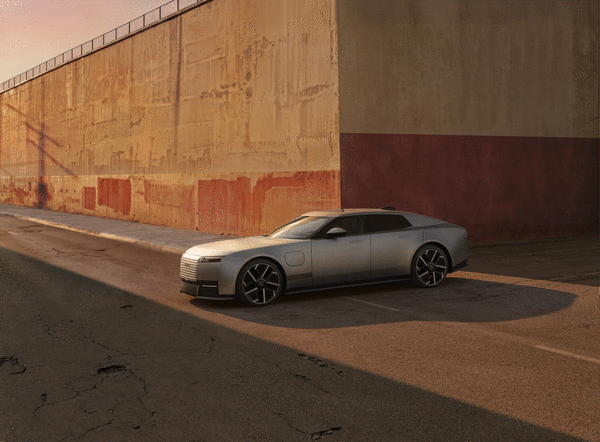
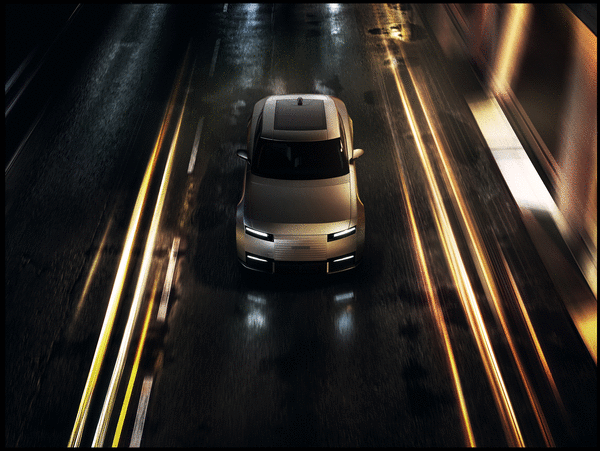



GAYDON, England — Jaguar has spent years talking about reinvention. Now it has produced something considerably more useful than another corporate promise: a 1,015-horsepower electric grand tourer with the proportions of a proper Jaguar. The Jaguar Type 01 is low, long and unapologetically expensive. It has a 24-inch screen, 23-inch wheels, three electric motors and enough torque to make the rear tires reconsider their career choices.
But the most important thing about it isn't the power. It’s that Jaguar has finally built an electric car that seems designed around the idea that people might actually lust after it.
The Type 01 is the first production Jaguar built on the company's new Jaguar Electric Architecture, or JEA. That dedicated electric platform gives the designers considerably more freedom with the proportions, and they have used it enthusiastically. The roof is low, the hood is long, the front overhang is short, and the rear extends well beyond the cabin. The result is a four-door GT that looks more like a Jaguar than an exercise in aerodynamic accounting.
Jaguar describes the design philosophy as exuberant modernism, which explains the lack of visual clutter. Then come the E-Type and XJS echoes. Yet it’s not some desperate automotive séance in which yesterday’s grille is bolted onto tomorrow’s body and everyone stands around applauding the heritage. Instead, Jaguar raided its own genetic vault without dragging the corpse upstairs. There’s the long, low menace, the theatrical sweep, the unmistakable suggestion that this thing might actually have somewhere to be. This is Jaguar’s future. And it looks like a leopard has wandered into the boardroom, knocked over the PowerPoint and decided it was time to hunt again.
“It should have a sense of never having been seen before, a sense of nothing else.” said Andy Wheel, Jaguar’s director of design development.
Historically, Jaguar's greatest design moments have arrived when the company willingly abandoned what came before. Company co-founder Sir William Lyons did exactly that in 1961, when the XK150 was replaced by the E-Type. Seven years later, the Mark 2, S-Type and 420 were all replaced by the singular XJ6. Lyons understood what car companies frequently forget: Heritage is useful until it becomes a prison.
The Type 01 therefore doesn't attempt to recreate an old Jaguar. It attempts to establish a new one.
Underneath, Jaguar’s new kitty uses a 260-kW motor to drive the front wheels and twin 310-kW motors at the rear. They produce 1,015 horsepower and 1,007 pound-feet of torque, enough to reach 60 mph in 3.1 seconds, and accelerate from 62 to 112 mph in 4 seconds.
The car uses an 850-volt electrical architecture and a 118-kWh battery. Jaguar estimates up to 400 miles of range with 21-inch wheels and up to 320 miles during sustained highway driving at 75 mph.
The engineering isn't confined to straight-line performance. The Type 01 gets torque vectoring, active dampers, air springs and all-wheel steering. Jaguar says its 37.7-foot wall-to-wall turning circle gives the 208-inch-long car the maneuverability of something considerably smaller. Which should be useful when attempting to park it somewhere that was designed before the invention of 23-inch wheels.
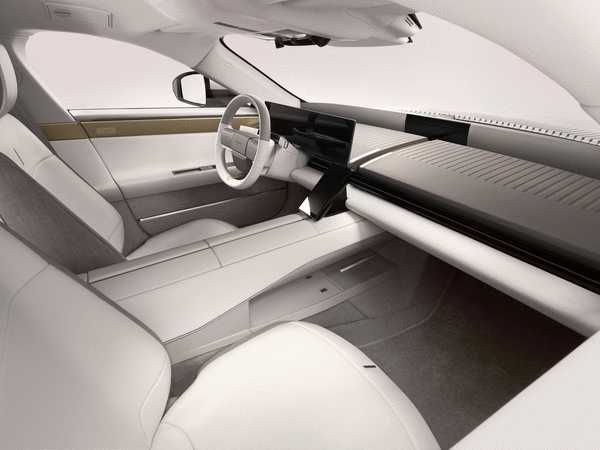
Meanwhile, inside, Jaguar has gone architectural. A central spine runs from front to rear, creating four individual spaces. Brass-inspired elements emphasize its length, while a 24-inch OLED display provides the driver's primary interface. A 7-inch touchscreen between the front seats handles commonly used controls, and rear passengers get their own 7-inch display. There’s a full-width Panoramic Soundbar at the base of the windshield, supplemented by speakers throughout the cabin and in the front-seat headrests. The digital rear-view display is integrated into the same area, which is helpful, as there’s no rear window.
The front seats are heated and cooled and equipped with a hot-stone massage. The rear seats are heated and cooled, while a panoramic glass roof floods the cabin with light. And there’s more than 15.9 cubic feet of cargo space behind the rear seats, expanding to more than 35 cubic feet with them folded.
But its most striking design element is what the company calls the “strike-through,” a cluster of parallel lines that start on the hood and continue onto the instrument panel. They’re also used at the rear of the vehicle, as well as accents on the fenders.
Jaguar plans to open the order books in early 2027, with the first cars expected to reach customers in the second half of the year. Starting at $130,500, the Type 01 sits above the Mercedes-Benz S-Class and BMW 7 Series, but below the considerably more rarefied air occupied by Bentley and Rolls-Royce. In other words, Jaguar is selling admission to a rather exclusive club.
The hard part isn’t building a brutally quick electric GT. Jaguar can do that. The question is whether the Type 01 looks enough like a Jaguar to make someone actually want one. That makes the design more important than the horsepower.
Electric cars excel at rationality. But nobody lusts after a Jaguar because it’s sensible. They want beauty, presence and enough recklessness to make the insurance company nervous. The Type 01 gets the memo. It isn’t trying to be a sensible EV. It’s trying to be a Jaguar that happens to be electric, with dramatic proportions, extravagant performance and the swagger of something that has absolutely no intention of behaving.
Jaguar isn’t erasing its past. It’s waking it up and remembering why anyone cares.
©2026 Tribune Content Agency, LLC










Comments