Solid crop, new varieties put shine on Michigan apple growers' outlook
Published in Business News
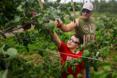

FENTON, Michigan — Leslie Slater walked into the Spicer Orchards market and took a deep breath.
“Isn’t that one of the best smells in the world?” she asked her family. For Slater, who lives in Milford, a trip to the orchard is an essential Midwestern fall experience.
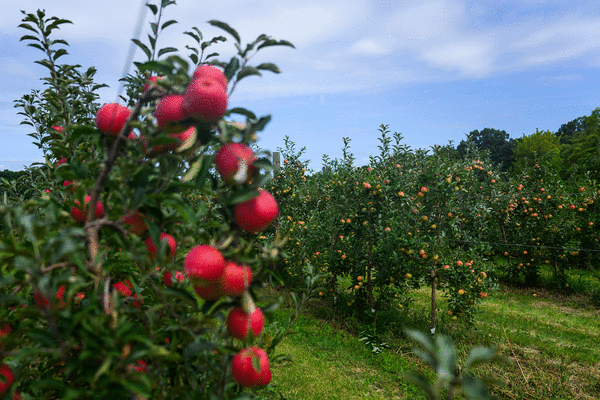
Michigan’s apple crop is shaping up to be solid this year despite an unusually long stretch of frost events in the spring, growers say. “We have a pretty good apple crop this year,” said Shannon Rowe of Spicer Orchards in Fenton, adding that the crop is about average in size, but quality is looking good.
A solid crop year matters not just to Michigan’s orchards, but to farm markets, grocery stores, restaurants and other businesses that depend on the fall harvest. Michigan is the nation’s second-largest apple-producing state, with 17.6 million apple trees in commercial production across 38,000 acres and about 850 family-run farms.
In 2025, the state’s growers produced about 1.06 billion pounds of apples, a crop valued at $322.5 million, according to the U.S. Department of Agriculture. The Michigan Apple Committee expects this year’s crop to exceed the USDA’s estimate of 25 million bushels, or about 1.05 billion pounds.
“The quality is amazing, and the size is larger, leading to more bushels,” Diane Smith, executive director of the Michigan Apple Committee, said in a statement.
While watching weather and yields, Michigan growers are also focusing on growing new varieties in response to consumer interest.
Shaking off the cold
Apple growers entered the spring unsure how the crop would fare after a slow start to the season and swings in temperatures and growth.
Kyle Rasch, a sixth-generation apple grower in Conklin in Ottawa County, said growers were concerned about losing more fruit as the crop advanced through its growth stages. A cool bloom period also made pollination more difficult because of the weather’s effect on bees.
“We were pretty nervous based on the spring. It was a nice slow start to the spring, but then things sped up, and then they slowed back down,” Rasch said.
By the end of May, Rasch said growers had a better idea that they would have a decent crop. He expects his 300-acre farm to produce fewer apples this year, but the fruit is larger. The timing of rain during the growing season has helped with size and quality.
“I would say this year we're definitely down on the total number of fruit that we have, but we've had a pretty, pretty good growing season for the most part,” he said.
At Spicer Orchards, Shannon Rowe said crews at the 300-acre orchard protected much of the apple crop during the spring's repeated frost events.
“We have frost fans at times," she said. "We have bonfires in the orchard. We use irrigation at times to help prevent frost from damaging the apples, and we were fortunate and lucky enough to be able to get through that tough frost event this spring."
The spring brought an unusually long run of frost events, Rowe said, with the 17 consecutive days at one point. Now, harvest is already underway, with early varieties such as Paula Red, Ginger Gold and Gala among the first apples coming to market, according to the Michigan Apple Committee.
Growing different varieties of apples can require different levels of attention, Rowe said: “Your more expensive apples typically require a lot more care in order to grow them. Some of them need to be hand-thinned. Some of them need to be trimmed differently.”
Some orchards have had to account for the growth of newer apple varieties, which can require more work in the orchard and have become increasingly popular with consumers.
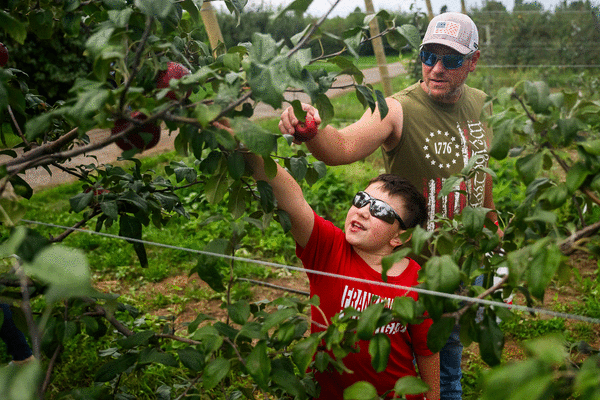
For Spicer Orchards, the fall season also means preparing for U-pick, which is already underway and expected to continue through the end of October. Now, the farm is growing about 95 varieties, Rowe said, up from about 75 a few years ago.
Finding new favorites
Social media has helped drive interest in newer varieties, as consumers see different apples online and become curious about trying them.
“A lot of times you'll see things on TikTok or they see things on social media about a certain kind of apple," Rowe said. "And I think people are highly interested in learning about all the different varieties and finding the one that's their favorite apple.”
Spicer will offer around five to seven newer varieties this year. Among them is KinderKrisp, which she said is a smaller but flavorful apple. People like it because it can fit in their lunch bag or box.
“That one's really crispy and interesting,” she said.
Discovering new varieties has become part of the experience at Spicer Orchard. Andrew Lee of Novi experienced that firsthand one recent Saturday with his wife and her parents, who were visiting from South Korea.
As they went down the line of apples to try in the fields, they came across one of the orchard's new varieties: Sweet Maia. After a quick sampling, they filled a bag with the dark red apples.
“They're delicious, they're juicy,” Lee said. The original plan was to make applesauce, but the apples were “too good to make sauce,” and he had a hunch they would just end up eating them all.
“I think these are our new favorite,” he said.
In Conklin, Rasch's farm grows about 15 varieties, including Gala, Honeycrisp and Ambrosia, along with Giant Gold and Golden Delicious, which are mostly grown for the processing market.
U-pick season grows
Derek Plotkowski, the Michigan State University Extension fruit educator for southeast Michigan, said newer varieties are increasingly being bred with specific characteristics in mind, including flavor, color, storage and disease resistance.
Older, commodity-style apples, such as Red Delicious, ship well and are easy to grow and manage, but people don’t “necessarily love the flavor very much," he said.
Many new varieties are more common in larger orchards on the west side of Michigan, which sell their apples to packhouses, where apples are sorted and graded before they are distributed to grocery stores.
Plotkowski also said different varieties are harvested at different times of the season. A U-pick farm can stay open longer if it offers apples harvested early and late.
“It allows you to extend your … visitor season,” he said.
A new variety, SweeTango, is a hybrid of Zestar! and Honeycrisp. It comes out early in the apple season and is “a little bit acidic,” Plotkowski said. EverCrisp, a hybrid of Honeycrisp and Fuji, is harvested in mid-October, giving customers another apple to pick later in the season.
At the Spicer Orchards market, several varieties were marked as new to the farm this year. Slater, the customer from Milford, said she always leaves with at least one bag of apples, and they make sure to always visit the bakery, too, for good measure.
“When guests come into town," she said, "we make sure to bring them here.”
©2026 www.detroitnews.com. Visit at detroitnews.com. Distributed by Tribune Content Agency, LLC.










Comments