Why GM is sticking with EVs as rivals pivot to hybrids
Published in Business News
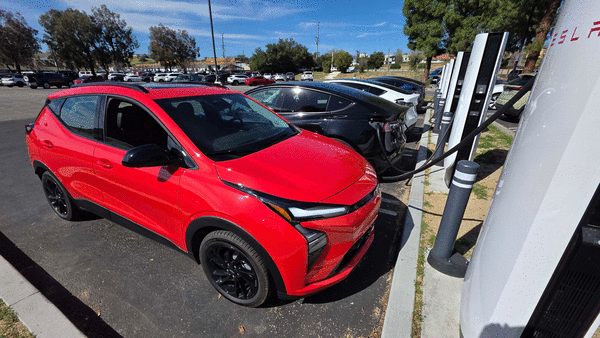
Electric vehicle sales have been falling, and hybrids are gaining traction. As rival brands jump on the hybrid bandwagon, why is General Motors Co. sticking with EVs?
The automaker is playing the long game, company leaders and industry analysts said. GM predicts EV sales — which peaked last year as buyers and lessees rushed to take advantage of expiring $7,500 federal tax incentives before dropping steeply in the fall — will eventually take off, despite sluggish adoption in the United States.
"Long term, it's going to be electric," Cox Automotive EV expert Stephanie Valdez Streaty said. "The rest of the world's going electric."
So as competitors Toyota Motor Corp. and Ford Motor Co. ramp up hybrid offerings GM has mostly chosen not to match, the Detroit automaker is working behind the scenes to make EV batteries cheaper while it generates cash making gas vehicles — chiefly full-sized pickups and SUVs.
"We continue to believe in EVs, and our portfolio brought almost 100,000 new customers to GM last year," CEO Mary Barra told investors earlier this year. "We know EV drivers don't often go back to ICE, so we'll continue executing our plan to dramatically reduce costs and to be well-positioned for the future. This will require continued investment, but at much lower levels."
Despite general industry optimism about EVs, automakers have been backing off EV production to match lower natural market demand without Democratic-supported incentives and emissions and gas mileage regulations. All three Detroit automakers have taken hefty charges on unused EV investments: $26 billion for Stellantis NV, $19.5 billion for Ford and $7.6 billion for GM.
GM, rivals face powertrain choices
With less government involvement, it's now up to automakers to predict which powertrain will drive the future: gas, hybrid or electric.
There are positives and negatives for GM to consider about whether to lean into hybrids, said Sam Abuelsamid, Telemetry auto analyst: "From a regulatory standpoint, they don't really have any reason to invest in hybrid technology. From a market standpoint, it's a little bit of a different situation."
A record 756,000 hybrid vehicles were sold in the final three months of 2025, according to Cox Automotive, and nearly 1 in 5 vehicles sold in that timeframe was a hybrid. Hybrid sales were up nearly 60% between December 2024 and 2025.
GM's competitors are taking notice. Ford has made big promises to offer hybrid options for nearly every model by 2030, and Stellantis CEO Antonio Filosa has said hybrids will be a priority given the segment's growth in the United States.
But with GM having sunk billions of dollars into EVs — plus more toward upping its U.S. manufacturing footprint and developing self-driving tech — the automaker has limited resources to pour into hybrids, Abuelsamid said.
"It fragments their efforts," he said. "I can see why they would want to stick with the EV strategy and do what they can on the (internal) combustion side."
Still, Valdez Streaty said GM likely has a strong enough gas and electric fleet "to keep them profitable while they're still focusing on EVs."
“This reset leaves a really interesting market for us to be able to grow into if we're willing to be patient," GM Chief Financial Officer Paul Jacobson told analysts last month. "We have an ability to incur some short-term losses, and with our portfolio, we have an opportunity to grow our share, and do it in a way that coincides with our improvements in profitability long term. It sets us up really, really well over the next three to five years.”
What competitors are doing
Toyota is the U.S. leader in hybrids with about 43% of sales of the combination powertrain, according to Cox. The Japanese automaker bet on hybrid powertrains decades ago with its still-popular Prius. Now it offers 18 hybrid models in the United States.
"They’ve already made that investment," Abuelsamid said. "This is not something new to them. They don't have to start from scratch. It makes sense for them to continue down this path."
Ford offers hybrid options on the Maverick and F-150 pickup trucks. The Escape compact SUV is available as a hybrid and plug-in hybrid, but the Dearborn automaker discontinued that vehicle in December to retool Louisville Assembly Plant in Kentucky for its next-generation electric vehicle.
"In the past, they've promised to expand their hybrid lineup," Abuelsamid said. "I haven't seen that yet."
Ford expects approximately 50% of its global volume will be hybrids, extended-range EVs and fully electric vehicles by 2030, up from 17% in 2025. Nearly every vehicle will have a hybrid or multi-energy powertrain choice by the end of the decade, according to the company.
Stellantis pivoted hard back toward its gas-burning lineup over the last year, putting the Hemi V-8 engine back into its mainstream Ram pickups and Jeep SUVs and axing its plug-in hybrid offerings for 2026. As for fully electric vehicles, Stellantis has lagged behind, and it's recently deemphasized those offerings as they have not sold in large numbers.
It is, however, offering the new Jeep Cherokee with a traditional hybrid powertrain.
"Compared to Ford and Stellantis, GM is obviously a lot further along with their EV strategy," Abuelsamid said. "They've got a much more robust EV lineup than their competitors do. I can understand why they would not want to over-invest in hybrid technology, because basically that puts one more thing on the table that you have to deal with."
The risk GM faces
Barra has said GM will offer another hybrid model in 2027. Currently, the only combination gas and electric GM vehicle is the $108,000 Corvette E-Ray hybrid, which uses a gas-powered V-8 engine and an electric motor to add horsepower.
Without a mass-appeal hybrid model, GM is banking on getting by with its gas lineup and 13-model passenger EV fleet.
The risk, analysts said, is missing out on what's now the only vehicle type that's growing in market share. And if hybrids surge in popularity along with gas prices, GM could miss out on a windfall.
"That could be problematic for GM," Abuelsamid said. "But they probably feel if that situation persists, if high gas persists, they can offer EVs as an alternative."
Metro Detroit auto dealer Paul Zimmerman said he'll continue offering a mix of gas, electric and hybrid options at his Matick Chevrolet, Buick, GMC and Toyota dealerships. He said while sales of GM EVs tanked after the tax credit ended last year, he's following GM's lead and trying to establish the dealerships as EV destinations.
But there's "absolutely demand for hybrids" among Toyota customers, he said: "Choices are good. That will end up determining the winners and who's betting on the right product."
(Detroit News Staff Writers Breana Noble and Luke Ramseth contributed.)
©2026 www.detroitnews.com. Visit at detroitnews.com. Distributed by Tribune Content Agency, LLC.










Comments