Michael Hiltzik: Those job numbers tell us that Trump's economy really stinks
Published in Business News
What a difference a year makes.
Last year at about this time, Elon Musk was boasting that his DOGE team could achieve $2 trillion in federal budget savings by paring down the government workforce. In November, President Trump announced plans to send $2,000 "tariff dividend checks" to all Americans "(not including high income people!)," he said.
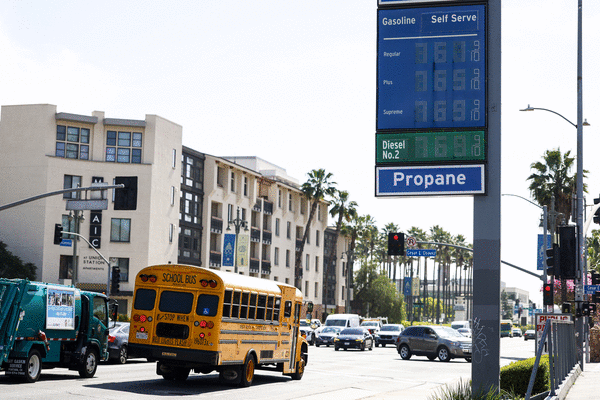
During his election campaign, Trump promised to cut gas and home electric bills in half. Late last year, he was claiming that gasoline prices had fallen below $2 a gallon in some parts of the country; during his recent State of the Union address, he asserted that gas was "below $2.30 a gallon in most states."
None of this has come to pass.
What's worse, the arrows on most charts of U.S. economic activity are pointing down. The exceptions are the inflation and unemployment rates, which are pointing up — and most of those charts covered a period prior to Trump's Iran war, which has sent gas prices and consequently inflation soaring.
The most notable blow to Trump's narrative of an ever-strengthening economy was delivered by the Bureau of Labor Statistics on Friday, when it reported that nonfarm payrolls had fallen by a startling 92,000 jobs in February. (Economists had expected a modest increase.)
Forecasts of U.S. gross domestic product in the current quarter ending March 31 reflect a high level of economic distress, though they don't currently point to a recession.
The GDPNow forecast of the Atlanta Federal Reserve Bank slid to an annual rate of 2.1% after Friday's jobs report, down from 3.1% as recently as Feb. 20. The New York Fed's GDP Nowcast has been drifting lower since early January, settling last week at an annualized 2.23% — not including the effect of the job numbers.
Economists who had kept a weather eye on jobs data all year detected an appreciable weakening in employment ever since Trump announced his "liberation day" tariffs on April 2.
All year long, the employment level has confounded the Trump administration's narrative. Its story was that job growth during the Biden administration was inflated by a rise in government and healthcare jobs (which it defined as "government-adjacent"). The promise was that Trump would rectify this imbalance as government workers moved into an ostensibly vibrant private sector.
It's true that government, private education and healthcare employment did dominate job growth toward the end of Biden's term, accounting for 73% of job growth in 2023-24, according to progressive economist Mike Konczal. But their domination continued into Trump's term, when they rose to 88% of job growth.
In 2025, Konczal notes, "health care continued to do the heavy lifting, while the rest of the labor market collapsed. The promised handoff from government-adjacent employment to private-sector dynamism never materialized."
Indeed, overall job growth disappeared during 2025, with nonfarm civilian employment falling by 213,000 from January 2025 through last month — and by 571,000 from April 2024, when Trump announced the "liberation" tariffs, through last month.
Jobs in manufacturing, which Trump specifically promised would benefit from his tariff regime, also fell — by 100,000 jobs since he took office, and by 89,000 jobs since April. (All figures are seasonally-adjusted.)
As for the administration's promise that mass deportations of immigrants would yield gains for native-born workers, that hasn't happened either. The unemployment rate for native-born workers rose to 4.7% in February from 4.4% a year earlier, outpacing the overall unemployment rate of 4.4%, according to the BLS.
Meanwhile, the employment pillar provided by healthcare and government jobs has been knocked away. Since October, the federal workforce has declined by 231,000, state employment has fallen by 17,000, and healthcare and private education jobs by 18,000.
Laypersons aren't particularly skilled at projecting economic trends into the future, but they're plainly unhappy about what they've seen lately at the supermarket and the gas pump. The University of Michigan's monthly consumer sentiment survey index rose slightly to 56.6 in February from 56.4 in January, but it was down by 12.5% from a year earlier, when it was 65.7.
The promise of more and better jobs isn't the only promise that Trump has broken. Early in 2025, Musk reduced his goal of federal budget savings to $1 trillion from $2 trillion. DOGE didn't come close to even the lower figure; DOGE currently estimates the savings from its rampage through the government rolls at $215 billion.
Tariff checks? As I reported last month, the Supreme Court ended the prospect of $2,000 tariff dividend checks when it declared most of Trump's tariffs to be unconstitutional.
Even before the Supreme Court's decision, tariff dividend checks looked like a flight of Trumpian fantasy. If $2,000 checks were paid over to most Americans, the cost would be as much as $600 billion, far outstripping the roughly $200 billion the government has collected in tariffs and therefore blowing a hole in the federal budget.
Following the court's decision, attention shifted to the prospect of tariff refunds, though those would go largely to the importers and big retailers that had paid the tariffs directly. Treasury Secretary Scott Bessent laughed off the idea that refunds would filter down to consumers: "I get a feeling the American people won't see it," he told an investment conference in Dallas after the court ruling.
Of course, even if Trump's checks were to go out, they would have represented a repayment of tariffs the public had paid, since it's black-letter economics that tariffs are a charge on importers and their domestic customers. And the implicit cost of the tariffs has been heavy — about $1,800 for the average U.S. household, according to the Yale Budget Lab.
In part due to the tariffs, inflation had crept up during 2025 and into this year. That was before the shock to oil prices delivered by Trump's war on Iran and the consequent closing of the Strait of Homuz, through which oil from Iran and much of the rest of the Middle East crosses to the outside world. Trump's gasoline-price claim, which was never credible, has been utterly shattered in the aftermath of the attack on Iran.
According to the AAA, the national average price of regular unleaded gas has shot up to $3.48 per gallon as of Monday, up from about $3 a week ago and $2.90 a month ago. And that's before the spot price of oil, which surged to about $120 per barrel Sunday before falling back to the mid-$90 level, has fully permeated prices at the pump.
It's reasonable to note how hard it is to predict how military actions and oil shocks will affect the economy and the investment markets over time. Of five oil shocks over the last 50 years tracked by SG Securities — in 2022, 2003, 1990, 1979 and 1973 — only the last three preceded a U.S. recession within the following 12 months. They were the Gulf War of 1990, the Iranian revolution in 1979 and the Yom Kippur War in 1973.
The stock market has tended to shrug off other military eruptions over the following years, even when share prices fell sharply upon the outbreak of hostilities. Indeed, a very nervous stock market, as tracked by the Standard & Poor's 500 index opened down 41 points Monday, a fall of about 1.6% from Friday's close, but was back in the green by nearly 56 points by Monday's close, after Trump said the Iran war is "very complete, pretty much."
A spike in oil prices, in any event, tends to affect some economic sectors more than others. The energy sector, for instance, outpaces the broad market as measured by the S&P 500 — as would be expected, since higher prices pump up the bottom lines of oil and gas producers. The losers are sectors that depend on oil as an input, such as capital goods manufacturers.
Where does all this leave us? Economic predictions are always dynamic, because so many factors affect growth and the course of many of them can be unforeseeable. If the Iran hostilities come to a prompt end, that would be a positive for the oil-dependent economy and stock prices. But stagnant employment has become a drag on the economy for at least the middle term.
Nor have the tariffs entirely gone away — Trump imposed 10% across-the-board duties immediately after the Supreme Court spoke and has talked of raising them to 15%.
In other words, the economic picture has turned noticeably dark.
The Magic 8-ball, that fortune-telling toy that was so popular in the 1950s and 1960s, had as useful a range of replies as any forecaster with an advanced degree in economics. Ask it whether the economy will improve in coming weeks or months, and its answers will range from "Yes definitely" to "Don't count on it." But as long as the economy remains in the hands of Donald Trump, the most accurate reply may be, "Ask again later."
©2026 Los Angeles Times. Visit at latimes.com. Distributed by Tribune Content Agency, LLC.








Comments