Larry Printz: A small town, a big factory and the SUV that changed one automaker's fortunes
Published in Business News
Few travelers discover West Point, Georgia, by leafing through a glossy brochure waiting in a hotel lobby. It sits quietly along the slow-moving Chattahoochee River, some 80 miles southwest of Atlanta, a town that has been minding its own business since 1831.
Nevertheless, history brushed past here with some force. The Battle of West Point, one of the Civil War’s closing arguments, left Fort Tyler in Union hands and secured the rail line between Atlanta and Montgomery, Alabama. Later came the steady hum of West Point Manufacturing, turning out textiles for a comfort-obsessed republic. But I don’t make my living pondering thread counts. I follow the automobile, that most transformative of American inventions, which has done more to shape the landscape, both physically and culturally, than any army or legislature.
And in recent years, West Point has found itself drawn into that story in a most consequential way.
This is where Kia Motors America planted its flag in 2006, erecting its principal U.S. manufacturing plant on the Georgia side of the river. It opened in 2009 on 2,200 acres, and within its vast, cathedral-like buildings, the company produces the Kia EV6, Kia EV9, Kia Sorento, Kia Sportage, and Kia Telluride.
The facility manufactures 350,000 units a year, a number that would have seemed unimaginable back when West Point’s fortunes rose and fell with cotton. It runs in the relentless cadence of modern industry: building a new Kia every 51 seconds, three shifts a day, five days a week, with maintenance carried out on weekends when the robots rest and the lines fall silent.
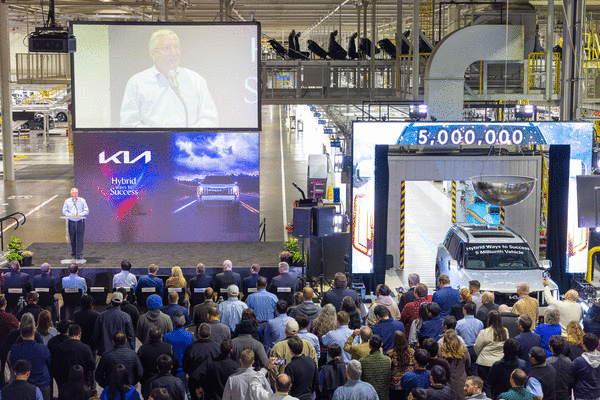
And it’s here, amid the steady choreography of conveyors and weld sparks, that Kia quietly crossed a threshold on Tuesday: producing its five-millionth vehicle in Georgia with the launch of the all-new 2027 Kia Telluride Hybrid.
“In the seven years since its debut in 2019, annual sales have more than doubled from 60,000 units to over 120,000,” said Sean Yoon, president and CEO of Kia North America and Kia Motors America, during a ceremony at the plant. “With the addition of the hybrid model, we are raising our target to 180,000 units, a 50 percent increase over last year, to meet overwhelming customer demand.”
Unsurprisingly, its unrelenting popularity has led company insiders to calling it the “Selluride.”
Yet, for all the routine of such ceremonial affairs, this one drew its predictable herd of politicians, each keen to be pictured beside something large, gleaming, and unmistakably prosperous. Among them was Georgia Governor Brian Kemp, who noted that the Telluride has become one of the company’s most conspicuous success stories, a point underscored by the decision to add one to the state’s vehicle fleet.
The 2027 Kia Telluride arrives wearing an all-new suit, though its mission remains familiar. It’s still a three-row, eight-passenger SUV, designed to swallow families, luggage, and the assorted clutter of modern life. Buyers may choose standard front-wheel drive or optional all-wheel drive, and power comes from either a turbocharged 2.5-liter gasoline engine or a 329-horsepower gas-electric hybrid. Pricing is expected to begin at less than $40,000, squarely in the realm of attainable aspiration, with further details to follow.
Milestones in the automobile business are curious things. They arrive without much fanfare on a shop floor that looks much as it did the day before. Yet they carry the accumulated weight of years spent learning, stumbling, and steadily improving. The new Kia Telluride stands as shorthand for how far Kia has come as an automaker. From its roots building funky, inexpensive pods like the Kia Soul, Kia has graduated to a flagship SUV that competes with vehicles costing much more, casting a favorable glow across its entire lineup.
Built exclusively in Georgia, the 2027 Kia Telluride has matured into a vehicle that owners and critics alike regard as a perfectly acceptable substitute for far pricier sport-utilities, delivering capability, comfort, and panache without the pretense of an inflated invoice. It’s proof that persistence can reshape a brand’s destiny.
Standing outside the factory, on a patch of red Georgia clay between the coastal plain and the rising hills, one can watch the future roll past in steel, aluminum, and electrons and be reminded that even the most unassuming towns sometimes find themselves at the center of automotive history.
©2026 Tribune Content Agency, LLC










Comments