India's regulator says grounded Boeing 787's switch 'satisfactory'
Published in Business News
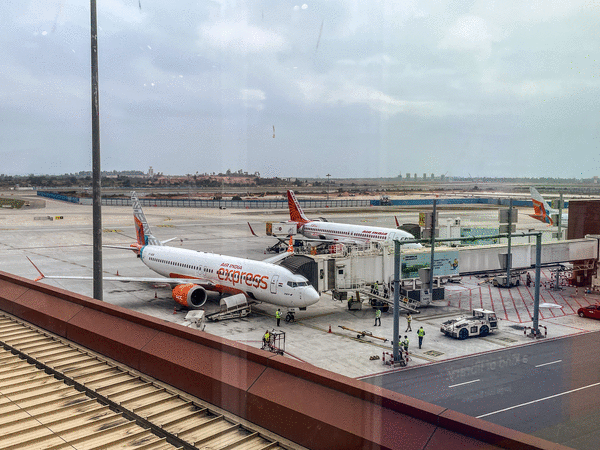
India’s aviation regulator said Tuesday it found no problems with an Air India Boeing 787 plane grounded the day before following a concern with the same fuel control switches tied to a deadly June crash.
India's Directorate General of Civil Aviation said in a statement Tuesday that the switches – two toggles that pilots use to control the flow of fuel to the engines – were “checked and found satisfactory.”
In a statement, the regulator said the switches remained secure after applying “full force” parallel to the base. But, the statement continued, applying pressure in the “incorrect direction” could cause the switches to “move easily.”
DGCA suggested Air India recirculate Boeing’s procedures for the fuel control switches.
The Monday incident raised concern among aviation safety advocates and onlookers because the same switches are at the center of India’s investigation into a deadly Air India 787 crash in Ahmedabad, India, in June. In that case, an Air India plane struggled to gain altitude after taking off and crashed into a medical college, killing 241 of the 242 people on board and 19 people on the ground.
India’s Aircraft Accident Investigation Bureau is still studying the crash. Its preliminary report released in July focused on movement of the two engine fuel control switches, which both shifted from the run to cutoff position about 1 second apart.
The cockpit voice recorder captured one pilot asking the other why they had moved the switches, India’s AAIB said in its report. The pilot responded that they had not done so.
The preliminary report also referenced a 2018 warning from the Federal Aviation Administration that it had received reports of fuel control switches installed without a locking feature engaged. Without the lock it would be easier for pilots to accidentally move the switches and inadvertently cut power to the engines.
The FAA said in 2018 and again in July that the reported issue did not pose a safety risk.
The switches came up again this week when an Air India pilot reported a “possible defect” with one of the fuel control switches on another 787 plane. That plane took off from London Sunday evening and landed safely in Bangalore, India, Monday morning, according to FlightAware.
After receiving the pilot’s report, Air India grounded the aircraft and contacted Boeing “to get the pilot’s concerns checked,” a spokesperson for the airline said. The airline also notified DGCA of the reported issue.
On Tuesday, DGCA said it had inspected the 787 with the reported problem, as well as another Air India 787 plane, and had not found a defect with the fuel control switches.
In its statement, DGCA said the Air India crew observed on two occasions during “engine start” in London that one of the fuel control switches did not “remain positively latched in the RUN position when light vertical pressure was applied.”
The switch latched correctly on the third attempt and “remained stable,” DGCA said. The crew completed the flight without further problems.
After the pilot’s report, DGCA inspected the switch and found it remained secure when “full force was applied parallel to the base plate.”
“However, applying external force in the incorrect direction caused the switch to move easily from run to cutoff, due to the angular base plate allowing slip when pressed improperly with finger or thumb,” the DGCA statement continued.
DGCA and Air India also inspected the switches’ “pull-to-unlock force” and found it was “within limits,” the statement continued. The switches are designed to require two motions to flip, pulling up and out.
Boeing said Monday it was in “contact with Air India and … supporting their review of this matter.”
The plane appeared to still be grounded on Tuesday; it has not flown since the London to Bangalore flight, according to FlightAware.
©2026 The Seattle Times. Visit seattletimes.com. Distributed by Tribune Content Agency, LLC.










Comments