Big retailers like Target increasingly hit by online refund fraud
Published in Business News
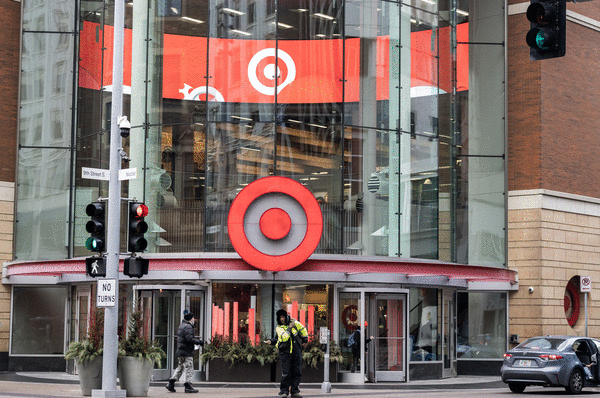
Noir Luxury Refunds marketed itself as an expert in helping consumers get refunds from retailers.
But its expertise was grounded in fraud, federal prosecutors say, and a Minnesota man is expected to be the 10th person to enter a guilty plea for the Noir racket.
Noir’s operatives spanned the country, though the fraud ring was allegedly run from Egypt. It’s one of several online refund fraud rings to have surfaced in recent years, generating big losses at major retailers such as Amazon, Walmart and Minneapolis-based Target.
“It is safe to assume that any retailer the size of Target or Best Buy have experienced this problem,” said J. Bennett, chief customer officer of Signifyd, an e-commerce fraud prevention firm. “We will be talking about online refund fraud more in the next few years.”
Leaders of internet refund fraud rings aren’t easy to pin down, though some have been prosecuted.
Amazon, the world’s largest online retailer, has aggressively pursued refund fraud rings in federal courts, including in a lawsuit naming two defendants who live within 70 miles of the Twin Cities.
Fraudulent and “abusive” returns totaled $103.8 billion in 2024 — equal to 15% of all U.S. retail sales, according to the fraud prevention software firm Appriss Retail and Deloitte, a prominent consultancy.
Refund fraud is part of the broader problem of return fraud, and both have long plagued physical retailers. But e-commerce transactions have grown rapidly since the COVID-19 pandemic, making up 28% of all U.S. retail sales in 2024, according to Appriss and Deloitte.
Fraudsters “are moving to online because there is more business there,” said Vishal Patel, Appriss’ chief product and technology officer. And online refund fraud is often easier to pull off than in-store scams.
These cheaters aren’t just dishonest shoppers, he added. “These are businesses.”
Noir crime ring tallied more than $1.5M in losses
Noir certainly ran like a business.
It advertised a “concierge” refund service on Telegram. More than 5,900 users “followed” the criminal ring between 2020 and 2022 on the Dubai-based social media platform.
Those customers would pay Noir a percentage of the product price — usually in cryptocurrency — in exchange for the organization fraudulently refunding the item on the customer’s behalf. The customers would keep the product.
Losses to retailers stung by Noir tallied $1.5 million to $3.5 million over the two years, according to federal prosecutors. The U.S. Attorney’s Office in northern Alabama credited Target and other major retailers with providing “assistance” in taking down Noir.
Nine people, mostly twentysomethings from several states, have pleaded guilty in an Alabama federal court to wire fraud and mail fraud conspiracy. They are awaiting sentencing.
Andre Johannes Ischler Simonet of the Northfield area was charged in Alabama with conspiracy to commit wire fraud and mail fraud in a 2023 indictment of Noir members. His role in the scheme is unclear.
Court records indicate Simonet, 24, is set to enter a guilty plea. Simonet could not be reached. An attorney who has represented him did not respond to requests for comment.
Prosecutors contend that a 21-year-old man in Alexandria, Egypt, ran the scheme. An Alabama federal grand jury indicted him in April.
Transactions had varying levels of sophistication
The Noir scam worked like this: A user would fill out an online form and select a valuable product, like designer clothing or electronics, to buy from a specific retailer. Noir then assigned a professional fraudster to pose as the user.
Different methods with varying degrees of sophistication were used to steal expensive merchandise.
In some cases, fraudsters would simply claim a box arrived empty. In others, shipping labels were manipulated, and malicious software was used to trick a retailer’s own inventory tracking to abuse its return policies.
As Noir grew in scale, so did its services. At one point the criminal organization created a “mentorship” training course for aspiring “refunders” — at a minimum $2,500 fee.
It also developed a travel service. Organizers discovered how to gain illicit access to airline employee benefit programs. A Russian known to federal investigators as “Yangboyz” helped steal airline miles from compromised loyalty accounts, according to the government.
Through its methods exploiting merchants, Noir also amassed stolen inventory that conspirators sold on eBay.
Federal prosectors in Oklahoma took down a similar online fraud ring, called Artemis, that operated from 2019 to 2023.
Ten people from across the country, all of them in their 20s, were indicted. Most of them have pleaded guilty to wire fraud.
The Artemis scheme caused millions of dollars in losses to several major retailers, prosecutors say, including Target, which also assisted prosecutors in that case.
Target declined an interview for this story.
In a statement, the company said it works internally to detect and stop fraud. “We also collaborate with external partners and retail-industry organizations to track, prevent and address emerging fraud trends.”
Other rings originated in Lithuania, Albania
Amazon isn’t waiting for criminal charges to punish alleged online fraud rings.
In four civil cases reviewed by the Minnesota Star Tribune, the online retailer sued the purported leaders of two rings, one a particularly large online refund scam from Lithuania, the other based in Albania.
In February, a federal judge in Washington hit the Lithuanian man who ran the Rekk refund ring with a $2 million default judgment. Four Amazon fulfillment center workers — insiders who profited from the Rekk scam — were hit with default judgments of $67,000 to $175,000.
Amazon is also pursing relatively small-time participants in organized refund fraud. Public records show no criminal charges for many of the defendants in the four Amazon suits.
Last year, Amazon sued the unknown operators of a refund fraud ring known as Chin Chopa. The suit’s eight named defendants were all users of the service, including one each from Lake City, Minnesota, and Menomonie, Wisconsin.
Chin Chopa was said to have operated on Telegram. “Customers are drawn to Chin Chopa channels under the false impression that Chin Chopa offers legitimate Amazon return services,” the suit said.
The Minnesota man paid Amazon $1,607 for three Quest virtual reality devices, engaging Chin Chopa to nab a fraudulent refund, Amazon claims.
Amazon was told the man received an empty box. The company requested a police report, but it was sent a fake. The Minnesota customer kept the product and got his money back. Chin Chopa got a commission.
Amazon claims the Wisconsin woman participated in a somewhat similar scam involving the sale of two desktop computers for $1,695. Both defendants settled with Amazon, agreeing to banishment from Amazon.com and the company’s online stores, court records show.
Since Amazon’s retail sales are completely online — and conducted on a huge scale — the company has a lot at stake, said Signifyd’s Bennett.
“They also offer a really generous return policy that you can take advantage of if you are not operating in good faith.”
The company is furthest ahead in rooting out online refund fraud, Bennett said. “Amazon is certainly a harbinger for the rest of online retail.”
©2025 The Minnesota Star Tribune. Visit at startribune.com. Distributed by Tribune Content Agency, LLC.










Comments