Citadel leaves Chicago tower as city alarmed by 'job killer' tax
Published in Business News
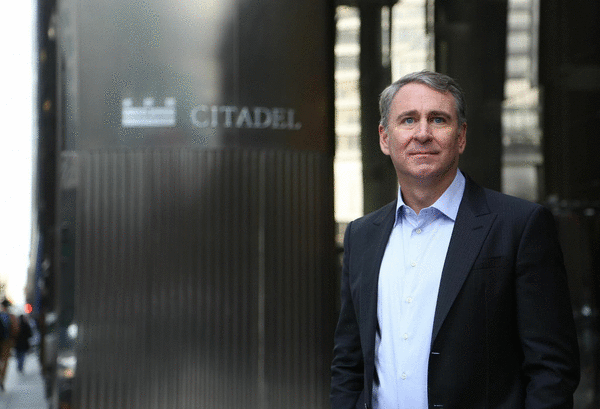
Citadel is shrinking its footprint in Chicago three years after billionaire owner Ken Griffin left for Florida, moving the company’s remaining operations in the city out of the downtown tower that was named for it, according to people familiar with the matter.
The company, which also shifted its headquarters to Miami in 2022, is relocating what’s left to a 50,000-square-feet space north of the Chicago River, said the people, who asked not to be named discussing private matters. The new space is about 10% of what Griffin’s financial firm occupied in 2020 as the Citadel Center’s main tenant. The 37-story tower is now for sale and no longer carries the name.
The firm, which once employed as many as 1,100 people in Chicago, has about 200 employees left in the city after relocations to Miami and New York, the people said.
Griffin’s exit — fueled by his public complaints about high taxes and crime in Chicago — is a cautionary tale for the city, business leaders say. Mayor Brandon Johnson, a progressive Democrat, is pushing for a large tax on corporations based on the number of employees. The City Council opposes the levy, which former mayor Rahm Emanuel, also a Democrat, once called a “job killer.”
Citadel isn’t the only company to leave the Chicago area in recent years. Boeing Co. and Caterpillar Inc. moved their headquarters elsewhere, and Tyson Foods Inc. shut its local offices. But Griffin’s decision to move most of his operations was by far the most high-profile exit, taking away highly paid jobs and millions in philanthropy.
“It’s important for the administration to demonstrate to the business community that they’re open for business,” said Oren Richland, managing principal at Dearborn Capital Group, a part owner of the building once called the Citadel Center on 131 South Dearborn Street in the central business district known as the Loop. “You want to bring the Citadels and the Caterpillars back into Chicago.”
Griffin donated more than $600 million to organizations in the Windy City. Chicago’s science museum got a $125 million gift from him and renamed itself the Kenneth C. Griffin Museum of Science and Industry. Since moving to Miami, he allocated about $325 million to institutions in Florida.
The top end of the Chicago’s real estate market also suffered, with Griffin losing about $30 million selling six of his condos in the affluent Gold Coast neighborhood. The sale of his seventh and last property in the city has yet to close.
The job market is also feeling the pinch. The number of finance roles in Illinois as a whole is down 2.7% since Griffin left to 397,000 in September, according to data from the state’s Department of Employment Security. That’s a big setback for Chicago, a city that gave birth to the modern futures industry in the late 1800s and is home to CME Group Inc. and Cboe Global Markets Inc., some of the top derivatives exchanges.
There were also shock waves in the political world. Lori Lightfoot, who downplayed Griffin’s exit when she ran Chicago, became the first mayor to lose a reelection bid in the third-largest U.S. city since 1983. In the end, the crime that the Citadel owner complained so much about was one of the reasons for her defeat.
While overall crime has fallen under Johnson, the multi-block area where Citadel’s former building is located still accounted for 9.3% of all the crimes reported over the past year in the police district that includes the Loop and a part of the South Loop neighborhoods. The multi-block area also accounted for one of nine murders registered in that police district.
Johnson’s popularity is also struggling — a poll earlier this year showed his approval rating at just 26%. Voters rejected his bid to increase the real estate transfer tax for homes sold for a $1 million or more, and Illinois Governor J.B. Pritzker, a Democrat, said he’d veto the mayor’s proposal to impose a levy on financial transactions.
The mayor, who risks missing his end-of-year deadline to pass a budget, also is facing opposition to what’s now a proposal for a $33-per-employee tax for companies with at least 500 employees, with the aim of raising $82 million for a public safety fund.
Common Ground Collective, a group backed by financier Michael Sacks and more than 100 donors, has been funding ads against Chicago’s so-called head tax. A large part of the criticism coming from civic and financial leaders has been directed at the mayor’s opposition to cutting spending — something both auditor EY and a taskforce of business leaders have suggested is necessary.
At a press conference about the implications of the head tax last week, Johnson imprecisely stated that while Griffin had left but “his people didn’t. Citadel is still here.”
The financial conglomerate, which has now moved to 353 North Clark Street — near the Magnificent Mile shopping area — will continue to downsize its presence in Chicago, the people said.
The company is expected to break ground on its Miami headquarters in the first quarter of 2026, with Related Companies, a New York-based firm, replacing Chicago-based Sterling Bay as the building’s developer, according to the people.
“You want expanding growing corporate relocations and participation for the jobs and economic development,” said Emanuel, who added that Chicago has lacked a growth strategy in recent years. “You want it because it becomes the support for your theaters, your museums, your music events, your dance communities that enrich the city.”
©2025 Bloomberg L.P. Visit bloomberg.com. Distributed by Tribune Content Agency, LLC.







Comments